

Sustainable Range
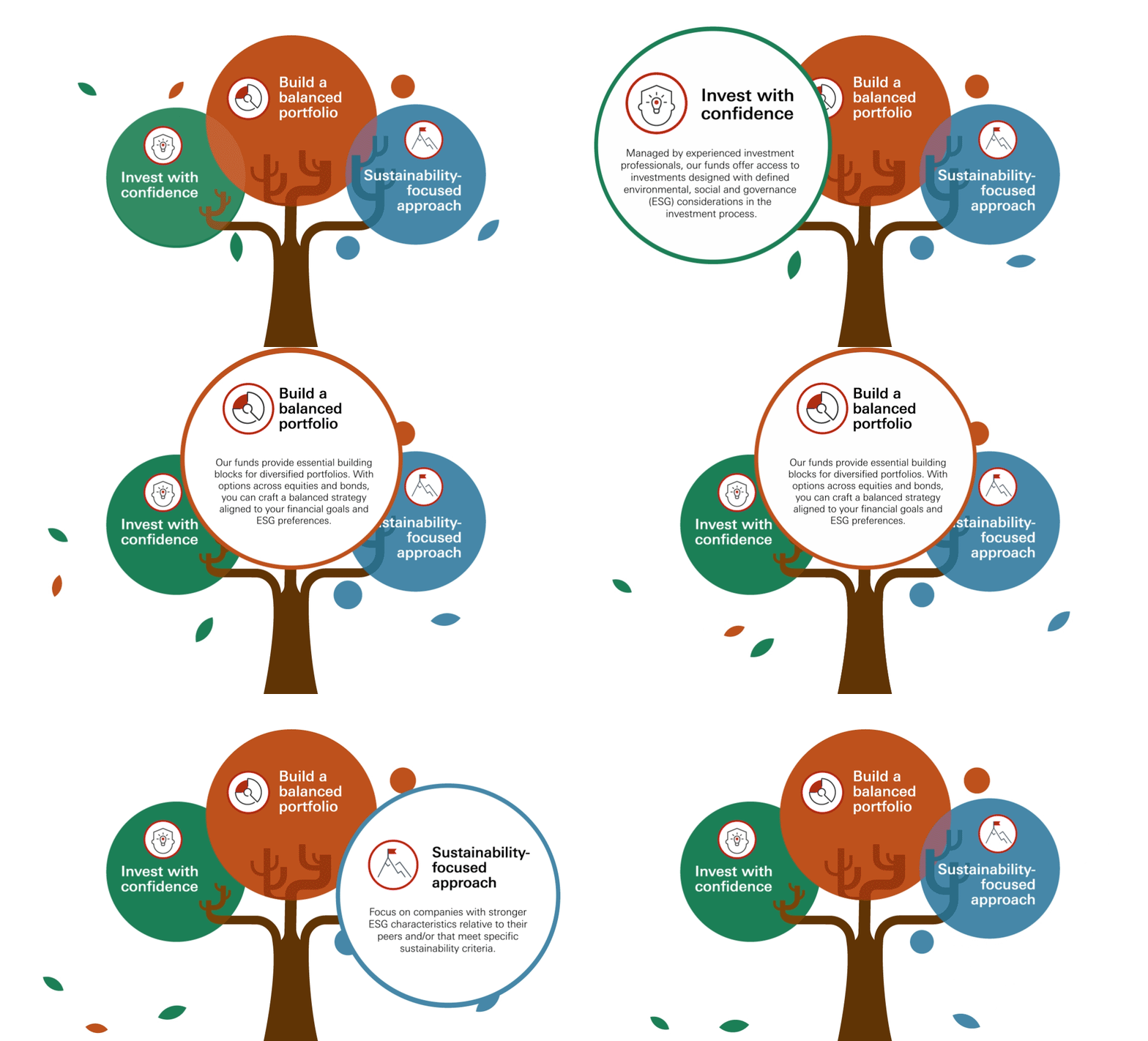
Investing sustainably can enhance a portfolio’s ability to minimise ESG risk and to target opportunities. We’ve built a sustainable fund range that embeds environmental, social and governance considerations into the investment process—helping you build an ESG-aware portfolio that also supports your financial goals and evolving regulatory expectations.
Explore our thematic opportunities
 |
|
More information |
 |
|
More information |
 |
|
More information |
 |
|
More information |
 |
|
More information |
 |
|
More information |
 |
|
More information |
 |
|
More information |
 |
|
More information |
 |
|
More information |
 |
|
More information |
 |
|
More information |
 |
|
More information |
 |
|
More information |
 |
|
More information |
 |
|
More information |
 |
|
More information |
 |
|
More information |
Why choose our Sustainable investment solutions:

Broad ESG passive range: Comprehensive ESG-aware and ESG-enhanced passive products across equities and fixed income, implemented successfully against multiple ESG and climate-aware index families from leading index providers using an established, repeatable process and ongoing index-provider engagement.

Flexible benchmark implementation: Our passive equity process is designed to work across different markets and universes and can incorporate client-specific guidelines (e.g., tracking error budgets, country/sector risk parameters and ESG requirements).

Proven indexing engine behind ESG delivery: Index-tracking heritage since 1988, with USD173.05bn in index equity + passively implemented quantitative equity (31 Dec 2025), bringing mature implementation discipline to ESG benchmarks.

Strong governance and controls: Robust pre-trade controls and automated monitoring plus independent risk oversight help ensure consistent delivery versus the chosen ESG benchmark.

Governance around ESG indices and data: Structured index provider selection and ongoing oversight focused on methodology robustness, data quality and ESG/climate approach—helping clients navigate a fast-evolving ESG index landscape.
Key Risks
The value of an investment in the portfolios and any income from them can go down as well as up and as with any investment you may not receive back the amount originally invested. Shariah investment restrictions may result in 'shariah compliant funds' performing less well than funds with similar objectives which are not subject to these restrictions.
- CoCo Bond Risk: Contingent convertible securities (CoCo bonds) are comparatively untested, their income payments may be cancelled or suspended, and they are more vulnerable to losses than equities and can be highly volatile.
- Callable Bond Risk: Any unexpected behaviour in interest rates could negatively impact the performance of callable debt securities (securities whose issuers have the right to pay off the security’s principal before the maturity date).
- Concentration Risk: The Fund may be concentrated in a limited number of securities, economic sectors and/or countries. As a result, it may be more volatile and have a greater risk of loss than more broadly diversified funds
- Counterparty Risk: The possibility that the counterparty to a transaction may be unwilling or unable to meet its obligations.
- Credit Risk: A bond or money market security could lose value if the issuer’s financial health deteriorates.
- Default Risk: The issuers of certain bonds could become unwilling or unable to make payments on their bonds.
- Derivatives Risk: Derivatives can behave unexpectedly. The pricing and volatility of many derivatives may diverge from strictly reflecting the pricing or volatility of their underlying reference(s), instrument or asset
- Emerging Markets Risk: Emerging markets are less established, and often more volatile, than developed markets and involve higher risks, particularly market, liquidity and currency risks
- Exchange Rate Risk: Changes in currency exchange rates could reduce or increase investment gains or investment losses, in some cases significantly
- Index Tracking Risk: To the extent that the Fund seeks to replicate index performance by holding individual securities, there is no guarantee that its composition or performance will exactly match that of the target index at any given time (“tracking error”)
- Interest Rate Risk: When interest rates rise, bond values generally fall. This risk is generally greater the longer the maturity of a bond investment and the higher its credit quality
- Investment Fund Risk: Investing in other funds involves certain risks an investor would not face if investing in markets directly. Governance of underlying assets can be the responsibility of third-party managers
- Investment Leverage Risk: Investment Leverage occurs when the economic exposure is greater than the amount invested, such as when derivatives are used. A Fund that employs leverage may experience greater gains and/or losses due to the amplification effect from a movement in the price of the reference source
- Liquidity Risk: Liquidity Risk is the risk that a Fund may encounter difficulties meeting its obligations in respect of financial liabilities that are settled by delivering cash or other financial assets, thereby compromising existing or remaining investors
- Operational Risk: Operational risks may subject the Fund to errors affecting transactions, valuation, accounting, and financial reporting, among other things
- Real Estate Investments Risk: Real estate and related investments can be negatively impacted by any factor that makes an area or individual property less valuable
- Sustainability Risk: Sustainability risk means an environmental, social or governance event or condition that, if it occurs, could cause an actual or a potential material negative impact on the value of the investment.
HSBC ETFs are sub-funds of HSBC ETFs plc (“the Company”), an investment company with variable capital and segregated liability between sub-funds, incorporated in Ireland as a public limited company, and is authorised by the Central Bank of Ireland. The company is constituted as an umbrella fund, with segregated liability between sub-funds. Shares purchased on the secondary market cannot usually be sold directly back to the Company. Investors must buy and sell shares on the secondary market with the assistance of an intermediary (e.g. a stockbroker) and may incur fees for doing so. In addition, investors may pay more than the current Net Asset Value per share when buying shares and may receive less than the current Net Asset Value per Share when selling them. UK based investors in HSBC ETFs plc are advised that they may not be afforded some of the protections conveyed by the Financial Services and Markets Act (2000), (“the Act”). The Company is recognised in the United Kingdom by the Financial Conduct Authority under section 264 of the Act. The shares in HSBC ETFs plc have not been and will not be offered for sale or sold in the United States of America, its territories or possessions and all areas subject to its jurisdiction, or to United States Persons. Affiliated companies of HSBC Asset Management (UK) Limited may make markets in HSBC ETFs plc. All applications are made on the basis of the current HSBC ETFs plc Prospectus, relevant Key Information Document (“KID”), Supplementary Information Document (SID) and Fund supplement, and most recent annual and semi-annual reports, which can be obtained upon request free of charge from HSBC Asset Management (UK) Limited, 8 Canada Square, Canary Wharf, London, E14 5HQ. UK, or from a stockbroker or financial adviser. The indicative intra-day net asset value of the sub-fund[s] is available on at least one major market data vendor terminal such as Bloomberg, as well as on a wide range of websites that display stock market data, including www.reuters.com. Investors and potential investors should read and note the risk warnings in the prospectus, relevant KID and Fund supplement (where available) and additionally, in the case of retail clients, the information contained in the supporting SID.
The value of investments and any income from them can go down as well as up and investors may not get back the amount originally invested. Where overseas investments are held the rate of currency exchange may also cause the value of such investments to fluctuate. Investments in emerging markets are by their nature higher risk and potentially more volatile than those inherent in some established markets. Stock market investments should be viewed as a medium to long term investment and should be held for at least five years. Any performance information shown refers to the past and should not be seen as an indication of future returns.
Content ID: D075677