

Accessing the infrastructure debt investment opportunity
Infrastructure debt investing has historically offered investors the potential to benefit from attractive risk-adjusted returns. The sector’s long-term growth is supported by several global trends, which are resulting in steadily increasing demand for debt financing.
According to the World Economic Forum, the total annual capital needed to deliver on cleantech1 and energy transition infrastructure by 2030 amounts to USD5 trillion2. The rapidly changing energy landscape in the developed world is gradually mirrored in emerging economies and is causing a shift in the operation of power grids.
Demand for electrical power is rising to keep pace with economic development, alongside energy efficiency regulations. Equally, an increasing reliance on renewable power drives both the redesign of power transmission networks and additional investment in energy storage that addresses the intermittency of power generation in a grid that becomes less reliant on fossil fuels.
Digital infrastructure has been a major source of demand for capital in the 21st century. The pace of growth has accelerated with the growing footprint of artificial intelligence in our daily lives, leading to recent estimates for USD1.7 trillion demand for investment capital until 20303.
Data centres are driving much of the demand for investment in the sector. A typical hyperscale data centre has a size of 50-100MW, and often higher. With the cost to build 1MW of capacity at cUSD10+ million4, the scale of energy demand is clear.
Opportunities can also be found in data connectivity. Dark fibre on trunk routes often comes with revenue models underpinned by long-term contracts with high-quality counterparties. While typically less capital intensive than data centres, it can provide an alternative route to digital infrastructure exposure, that can offer attractive and sustainable investment yields.
Energy transition and digital infrastructure, however, are just the tip of the infrastructure opportunity iceberg. The infrastructure sector is diverse, underpinning every aspect of the economy, and naturally shaped by global economic, demographic and geopolitical trends.
The changing environment following the COVID pandemic fuelled a process of de-globalisation and re-onshoring of economic activities as governments re-designed supply chains to meet changing priorities around production processes and supply security of critical resources, particularly in the developed world. This trend is generating demand for investment in logistics facilities and transportation infrastructure above the significant5 capital required to maintain, upgrade, and expand current ageing infrastructure. According to McKinsey, an estimated USD106 trillion in investment will be required through 2040 to meet the need for new and updated infrastructure.6
In many projects, debt financing represents the majority of funding in a typical infrastructure project. The large capital requirements of the energy transition, and AI and digitalisation, combined with the scaling back of traditional lenders from long-duration lending has fuelled the development of new ways to access infrastructure debt investments.
Historically, however, investor appetite has been focused on infrastructure equity. As the graph below shows, despite significant growth, dry powder in infrastructure debt has not kept pace with infrastructure equity.
Growth in dry powder across infrastructure debt and equity
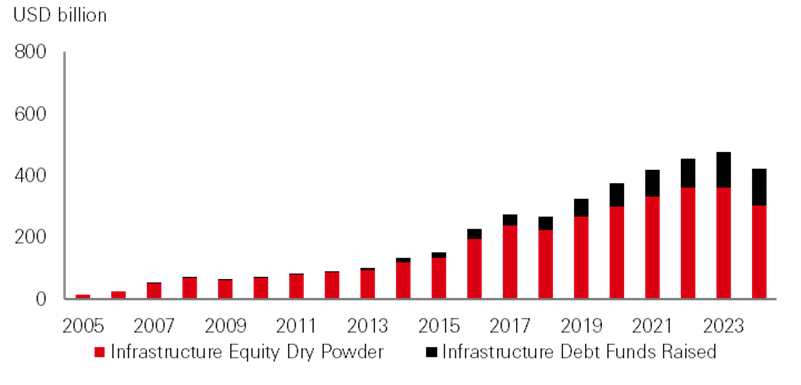
Source: Preqin 2024
As equity capital is more readily available than debt financing, this can result in more robust and lender-friendly financing structures, with covenants and features that support a borrower’s credit profile, while offering the potential for attractive yields.
Accessing the opportunity
Infrastructure debt investing has often been associated with long-term fixed rate debt investments, often with an investment grade rating. While this part of the market is well established and offers potential benefits for institutional investors, (such as insurance firms seeking to deliver asset-liability matching to their balance sheet), the sector has grown to offer several differentiated strategies that cater to different investor priorities in terms of yield, risk, and sector exposure.
These can include strategies which target higher returns by appealing to certain investors’ appetite for higher risk, by focusing on Second Lien7 and Holdco Debt8 investments.
Some managers adopt a different approach to delivering high yields, by adopting a direct origination and structuring approach, which keeps most of the economics in a deal with the end investor. They may also focus on smaller transactions, thereby offering the potential for an illiquidity premium. Others may adopt a more thematic approach, by offering investors access to trends including digital infrastructure and energy transition.
Infrastructure debt offers a variety of choice in both returns and duration, as well as exposure across different credit profiles and origination approaches. Effective participation depends on aligning investment objectives and risk tolerance with the appropriate manager and strategy.
Across strategies and sector themes, disciplined credit underwriting remains central to infrastructure debt investing. Whether targeting investment grade or higher-yielding opportunities, managers should apply consistent credit analysis, focusing on sustainable cash flows and structures designed to mitigate asset-specific risks.
The views expressed below are held at the time of preparation and are subject to change without notice. Any forecast, projection or target where provided is indicative only and is not guaranteed in any way. HSBC Asset Management accepts no liability for any failure to meet such forecast, projection, or target.
1 Cleantech (short for clean technology) refers to products, services, and processes designed to enhance resource efficiency, lower costs, and reduce greenhouse gas emissions
2 ‘Accelerating the Energy Transition: Unpacking the Business and Economic Cases’, WEF (2025)
3 Omdia Cloud and Data Center Market Snapshot December 2025
4 ‘Data Center Buildout Cost: Complete Pricing Guide’, Aptly Technology (2026)
5 The American Society of Civil Engineers (March 2025), estimated a need for USD 9.1 trillion for ageing infrastructure by 2033 in the US alone
6 McKinsey & Company, The Infrastructure Moment (Sep 2025)
7 Second-lien debt is a type of secured loan that is repaid only after all first-lien (senior) loans are fully satisfied in the event of a borrower's bankruptcy or liquidation. Because this subordinated position increases the lender's risk of not recovering their capital, second-lien debt typically carries higher interest rates than senior debt
8 HoldCo (Holding Company) debt is a loan taken out by a parent company that sits above operating subsidiaries (OpCos). The parent company does not directly generate revenue from operations. Instead, it relies on dividends and interest from the operating companies beneath it to service the debt
Disclaimer
Important Information
For Professional Clients and intermediaries within countries and territories set out below; and for Institutional Investors and Financial Advisors in the US. This document should not be distributed to or relied upon by Retail clients/investors.
The value of investments and the income from them can go down as well as up and investors may not get back the amount originally invested. The performance figures contained in this document relate to past performance, which should not be seen as an indication of future returns. Future returns will depend, inter alia, on market conditions, investment manager’s skill, risk level and fees. Where overseas investments are held the rate of currency exchange may cause the value of such investments to go down as well as up. Investments in emerging markets are by their nature higher risk and potentially more volatile than those inherent in some established markets. Economies in emerging markets generally are heavily dependent upon international trade and, accordingly, have been and may continue to be affected adversely by trade barriers, exchange controls, managed adjustments in relative currency values and other protectionist measures imposed or negotiated by the countries and territories with which they trade. These economies also have been and may continue to be affected adversely by economic conditions in the countries and territories in which they trade.
The contents of this document may not be reproduced or further distributed to any person or entity, whether in whole or in part, for any purpose. All non-authorised reproduction or use of this document will be the responsibility of the user and may lead to legal proceedings. The material contained in this document is for general information purposes only and does not constitute advice or a recommendation to buy or sell investments. Some of the statements contained in this document may be considered forward looking statements which provide current expectations or forecasts of future events. Such forward looking statements are not guarantees of future performance or events and involve risks and uncertainties. Actual results may differ materially from those described in such forward-looking statements as a result of various factors. We do not undertake any obligation to update the forward-looking statements contained herein, or to update the reasons why actual results could differ from those projected in the forward-looking statements. This document has no contractual value and is not by any means intended as a solicitation, nor a recommendation for the purchase or sale of any financial instrument in any jurisdiction in which such an offer is not lawful. The views and opinions expressed herein are those of HSBC Asset Management at the time of preparation and are subject to change at any time. These views may not necessarily indicate current portfolios' composition. Individual portfolios managed by HSBC Asset Management primarily reflect individual clients' objectives, risk preferences, time horizon, and market liquidity. Foreign and emerging markets: investments in foreign markets involve risks such as currency rate fluctuations, potential differences in accounting and taxation policies, as well as possible political, economic, and market risks. These risks are heightened for investments in emerging markets which are also subject to greater illiquidity and volatility than developed foreign markets. This commentary is for information purposes only. It is a marketing communication and does not constitute investment advice or a recommendation to any reader of this content to buy or sell investments nor should it be regarded as investment research. It has not been prepared in accordance with legal requirements designed to promote the independence of investment research and is not subject to any prohibition on dealing ahead of its dissemination. This document is not contractually binding nor are we required to provide this to you by any legislative provision.
All data from HSBC Asset Management unless otherwise specified. Any third-party information has been obtained from sources we believe to be reliable, but which we have not independently verified.
HSBC Asset Management is the brand name for the asset management business of HSBC Group, which includes the investment activities that may be provided through our local regulated entities. HSBC Asset Management is a group of companies in many countries and territories throughout the world that are engaged in investment advisory and fund management activities, which are ultimately owned by HSBC Holdings Plc. (HSBC Group).
- In Australia, this document is issued by HSBC Bank Australia Limited ABN 48 006 434 162, AFSL 232595, for HSBC Global Asset Management (Hong Kong) Limited ARBN 132 834 149 and HSBC Global Asset Management (UK) Limited ARBN 633 929 718. This document is for institutional investors only and is not available for distribution to retail clients (as defined under the Corporations Act). HSBC Global Asset Management (Hong Kong) Limited and HSBC Global Asset Management (UK) Limited are exempt from the requirement to hold an Australian financial services license under the Corporations Act in respect of the financial services they provide. HSBC Global Asset Management (Hong Kong) Limited is regulated by the Securities and Futures Commission of Hong Kong under the Hong Kong laws, which differ from Australian laws. HSBC Global Asset Management (UK) Limited is regulated by the Financial Conduct Authority of the United Kingdom and, for the avoidance of doubt, includes the Financial Services Authority of the United Kingdom as it was previously known before 1 April 2013, under the laws of the United Kingdom, which differ from Australian laws;
- In Bermuda, this document is issued by HSBC Global Asset Management (Bermuda) Limited, of 37 Front Street, Hamilton, Bermuda which is licensed to conduct investment business by the Bermuda Monetary Authority;
- In France, Belgium, Netherlands, Luxembourg, Portugal, Greece, Finland, Norway, Denmark, Spain and Sweden this document is issued by HSBC Global Asset Management (France), a Portfolio Management Company authorised by the French regulatory authority AMF (no. GP99026);
- In Germany, this document is issued by HSBC Global Asset Management (Deutschland) GmbH which is regulated by BaFin (German clients) respective by the Austrian Financial Market Supervision FMA (Austrian clients);
- In Hong Kong, this document is issued by HSBC Global Asset Management (Hong Kong) Limited, which is regulated by the Securities and Futures Commission. This content has not been reviewed by the Securities and Futures Commission;
- In India, this document is issued by HSBC Asset Management (India) Pvt Ltd. which is regulated by the Securities and Exchange Board of India;
- In Italy, this document is issued by HSBC Global Asset Management (France), a Portfolio Management Company authorised by the French regulatory authority AMF (no. GP99026), through its Italian branch, regulated by Banca d’Italia and Commissione Nazionale per le Società e la Borsa (Consob);
- In Japan, this document is issued by HSBC Asset Management (Japan) Ltd (JRN 3010001124868), regulated by the Financial Services Agency;
- In Malta, this document is issued by HSBC Global Asset Management (Malta) Limited which is regulated and licensed to conduct Investment Services by the Malta Financial Services Authority under the Investment Services Act;
- In Mexico, this document is issued by HSBC Global Asset Management (Mexico), SA de CV, Sociedad Operadora de Fondos de Inversión, Grupo Financiero HSBC which is regulated by Comisión Nacional Bancaria y de Valores;
- In the United Arab Emirates, this document is issued by HSBC Investment Funds (Luxembourg) S.A. – Dubai Branch (Level 20, HSBC Tower, PO Box 66, Downtown Dubai, United Arab Emirates) regulated by the Capital Market Authority (CMA) in the UAE to conduct investment fund management, portfolios management, fund administration activities (CMA Category 2 license No.20200000336) and promotion activities (CMA Category 5 license No.20200000327).
- In the United Arab Emirates, this document is issued by HSBC Global Asset Management MENA, a unit within HSBC Bank Middle East Limited, U.A.E Branch, PO Box 66 Dubai, UAE, regulated by the Central Bank of the U.A.E. and the Capital Market Authority in the UAE under CMA license number 602004 for the purpose of this promotion and lead regulated by the Dubai Financial Services Authority. HSBC Bank Middle East Limited is a member of the HSBC Group and HSBC Global Asset Management MENA are marketing the relevant product only in a sub-distributing capacity on a principal-to-principal basis. HSBC Global Asset Management MENA may not be licensed under the laws of the recipient’s country of residence and therefore may not be subject to supervision of the local regulator in the recipient’s country of residence. One of more of the products and services of the manufacturer may not have been approved by or registered with the local regulator and the assets may be booked outside of the recipient’s country of residence.
- In Singapore, this document is issued by HSBC Global Asset Management (Singapore) Limited, which is regulated by the Monetary Authority of Singapore. The content in the document/video has not been reviewed by the Monetary Authority of Singapore;
- In Switzerland, this document is issued by HSBC Global Asset Management (Switzerland) AG. This document is intended for professional investor use only. For opting in and opting out according to FinSA, please refer to our website; if you wish to change your client categorization, please inform us. HSBC Global Asset Management (Switzerland) AG having its registered office at Gartenstrasse 26, PO Box, CH-8002 Zurich has a licence as an asset manager of collective investment schemes and as a representative of foreign collective investment schemes. Disputes regarding legal claims between the Client and HSBC Global Asset Management (Switzerland) AG can be settled by an ombudsman in mediation proceedings. HSBC Global Asset Management (Switzerland) AG is affiliated to the ombudsman FINOS having its registered address at Talstrasse 20, 8001 Zurich. There are general risks associated with financial instruments, please refer to the Swiss Banking Association (“SBA”) Brochure “Risks Involved in Trading in Financial Instruments”;
- In Taiwan, this document is issued by HSBC Global Asset Management (Taiwan) Limited which is regulated by the Financial Supervisory Commission R.O.C. (Taiwan);
- In Turkiye, this document is issued by HSBC Asset Management A.S. Turkiye (AMTU) which is regulated by Capital Markets Board of Turkiye. Any information here is not intended to distribute in any jurisdiction where AMTU does not have a right to. Any views here should not be perceived as investment advice, product/service offer and/or promise of income. Information given here might not be suitable for all investors and investors should be giving their own independent decisions. The investment information, comments and advice given herein are not part of investment advice activity. Investment advice services are provided by authorized institutions to persons and entities privately by considering their risk and return preferences, whereas the comments and advice included herein are of a general nature. Therefore, they may not fit your financial situation and risk and return preferences. For this reason, making an investment decision only by relying on the information given herein may not give rise to results that fit your expectations.
- In the UK, this document is issued by HSBC Global Asset Management (UK) Limited, which is authorised and regulated by the Financial Conduct Authority;
- In the US, this document is issued by HSBC Securities (USA) Inc., an HSBC broker dealer registered in the US with the Securities and Exchange Commission under the Securities Exchange Act of 1934. HSBC Securities (USA) Inc. is also a member of NYSE/FINRA/SIPC. HSBC Securities (USA) Inc. is not authorized by or registered with any other non-US regulatory authority. The contents of this document are confidential and may not be reproduced or further distributed to any person or entity, whether in whole or in part, for any purpose without prior written permission.
- In Chile, operations by HSBC's headquarters or other offices of this bank located abroad are not subject to Chilean inspections or regulations and are not covered by warranty of the Chilean state. Obtain information about the state guarantee to deposits at your bank or on www.cmfchile.cl;
- In Colombia, HSBC Bank USA NA has an authorized representative by the Superintendencia Financiera de Colombia (SFC) whereby its activities conform to the General Legal Financial System. SFC has not reviewed the information provided to the investor. This document is for the exclusive use of institutional investors in Colombia and is not for public distribution;
- In Costa Rica, the Fund and any other products or services referenced in this document are not registered with the Superintendencia General de Valores (“SUGEVAL”) and no regulator or government authority has reviewed this document, or the merits of the products and services referenced herein. This document is directed at and intended for institutional investors only.
- In Peru, HSBC Bank USA NA has an authorized representative by the Superintendencia de Banca y Seguros in Perú whereby its activities conform to the General Legal Financial System - Law No. 26702. Funds have not been registered before the Superintendencia del Mercado de Valores (SMV) and are being placed by means of a private offer. SMV has not reviewed the information provided to the investor. This document is for the exclusive use of institutional investors in Perú and is not for public distribution;
- In Uruguay, operations by HSBC's headquarters or other offices of this bank located abroad are not subject to Uruguayan inspections or regulations and are not covered by warranty of the Uruguayan state. Further information may be obtained about the state guarantee to deposits at your bank or on www.bcu.gub.uy.
Copyright © HSBC Global Asset Management Limited 2026. All rights reserved. No part of this publication may be reproduced, stored in a retrieval system, or transmitted, on any form or by any means, electronic, mechanical, photocopying, recording, or otherwise, without the prior written permission of HSBC Asset Management.
Content ID: D071506 ; Expiry Date: 21.05.2027