

Investing Across a New Inflation Regime
Foreword
By Stephen D King, HSBC Senior Economic Adviser, Author of We Need to Talk About Inflation (Yale University Press, 2023)
Inflation’s Return and a Regime Shift in Rates
Inflation has returned. Many thought it was an economic problem buried in history books. No longer. Since the onset of Covid, central banks have struggled to bring inflation to heel. For many years, and particularly after the 2008 Global Financial Crisis - inflation was too low. Policymakers feared that Japan’s deflationary malaise, a world in which prices were falling, would spread elsewhere. That narrative is no longer relevant. Since 2021, inflation in the developed world has been either at or above target. The cost of keeping inflation under control has risen. Central bank policy rates are much higher than they once were. The bull market in bonds, which dragged long term interest rates lower from the early-1980s onwards, has abruptly reversed.
Temporary Shocks vs Deeper-Rooted Inflation Drivers
Some would argue that recent inflationary troubles are merely temporary in nature, a consequence of a series of unfortunate events. Covid led to supply shortages. Russia’s invasion of Ukraine temporarily lifted natural gas prices. The Iran War closed the Strait of Hormuz and led to higher and more volatile oil prices. All of this is true. Yet the persistence of inflationary overshoots may also reflect other, more deep-rooted, drivers. In the early stages of the Covid pandemic, central banks offered huge amounts of monetary support. For them, the primary macroeconomic challenge was a shortfall in demand, not supply. When inflation first began to rise, it was, apparently, a transitory phenomenon. That language was eventually abandoned. Central banks finally raised interest rates. By that stage, however, the public had figured that their monetary masters were not omniscient after all. If central banks could make mistakes, maybe inflation wasn’t dead and buried.
Debt, Fiscal Strain and the Temptation to Inflate
At the same time, many began to fret about seemingly relentless increases in government debt. In the UK, where data extends back hundreds of years, it’s safe to say that, in peacetime, we have never before witnessed such huge gains. Budgetary authorities, including the CBO in the US and the OBR in the UK, project further massive increases in coming decades. Slow growth (and, hence, slow revenue growth), population ageing (adding to pension and healthcare spending), heightened defence spending and higher debt service costs threaten to deliver persistently large budget deficits year after year.
Achieving fiscal stability under these circumstances is a huge political challenge. If taxes are already high and spending cuts are politically unachievable, the remaining options are both limited and fraught with risk. Indulge in financial repression, rigging capital markets to allow government to jump to the front of the credit queue. Default. Devalue. Or, in time honoured fashion, inflate. From the Ancient Romans through to Revolutionary France, and from the Confederacy during the American Civil War through to 1970s Britain and its IMF bailout, desperate leaderships have too often turned to the printing press. Unanticipated inflation always rewards the debtor at the expense of the creditor.
Perhaps this time will be different. Elon Musk talks about an AI-inspired age of abundance, in which prices are more likely to fall than rise. Unlike much of the developed world, China is suffering deflation (it’s no coincidence that its central bank did not loosen monetary policy to match the Federal Reserve, the European Central Bank and others in the early stages of the Covid crisis). Nevertheless, once established, inflation is a mightily difficult beast to slay. A central banker once defined “price stability” as a situation in which no one is talking about inflation. On that definition, we’re still a long way from home.
Macroeconomic Environment
Is inflation targeting under threat?
Summary
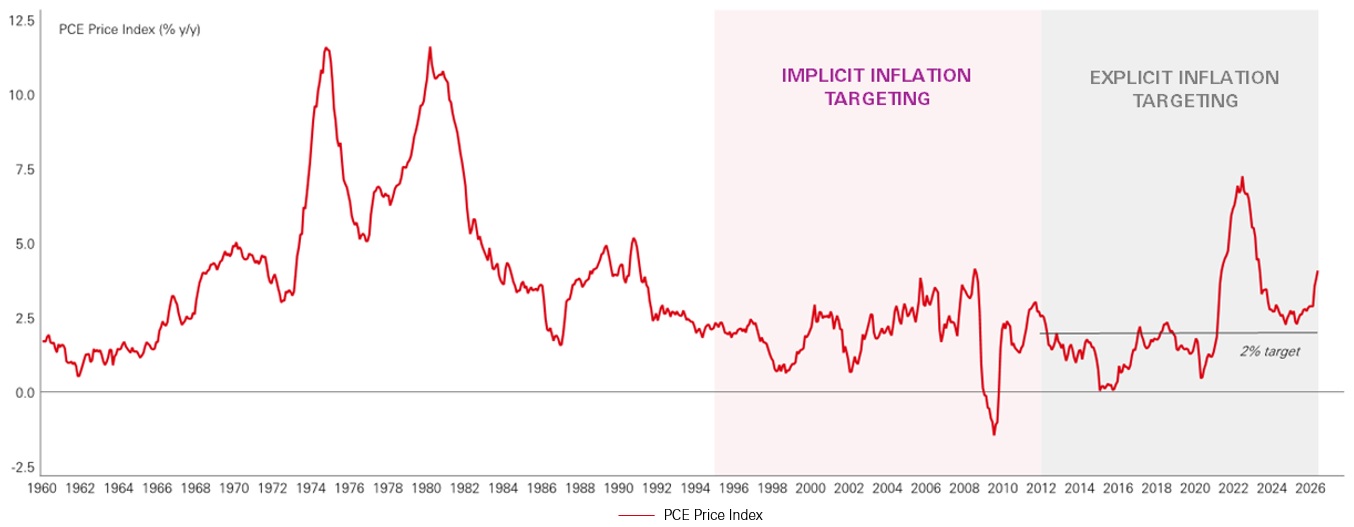
- US post-war inflation can be read through three distinct regimes: high/volatile (1960s to the early 1980s), disinflation (Volcker onwards), and a long low/stable period (mid‑1990s – 2020)
- Since the pandemic, that stability has broken: US PCE* inflation has averaged around 4.0 per cent since 2021, versus a 1.8 per cent average over the prior 25 years
- Base case isn’t a return to 1970s-style inflation, but it may be a world of greater volatility, where 2 per cent behaves more like a floor than a ceiling
US post-war inflation can be framed as three regimes: high and volatile inflation from the 1960s to early 1980s when inflation control wasn’t prioritised; disinflation from the Volcker era onwards; and a long period of stable, low inflation from the mid‑1990s to 2020 as the Federal Reserve adopted de facto inflation targeting (implicit from the mid‑1990s and explicit from 2012). Over that c. 25-year span prior to the pandemic, US PCE inflation averaged 1.8 per cent.
Since the pandemic, that performance has deteriorated. US PCE inflation has averaged around 4.0 per cent since 2021, around double the Fed’s 2 per cent objective, and has risen again following an oil price shock. The key question is whether this marks a shift to a structurally higher inflation regime.
The base case is not a return to pre‑1990s inflation, but a world of greater inflation volatility, with 2 per cent acting more like a floor than a ceiling compared with the 2010s. Three forces could make inflation pressures more persistent this decade: more frequent supply shocks (deglobalisation, geopolitics, climate impacts), ageing-driven labour supply constraints (especially if immigration is restricted), and fiscal strain with already-high debt and rising entitlement spending pressures (social security and pensions).
Click the image to enlarge
The central thesis is that inflation is a choice: shocks can’t be prevented, but credible and willing policymakers can keep average inflation low. Upside risks include a gradual ratchet up in expectations caused by more frequent supply-side shocks and, less likely but more disruptive, fiscal dominance leading to a change in the inflation-targeting framework.
*PCE - Personal consumption expenditures price index.
Multi-Asset
Equity-Bond diversification is challenged in higher inflation regimes
Summary
- Broaden diversification: As equity/bond diversification becomes less reliable in higher inflation, consider complementing traditional allocations with real assets, commodities and liquid alternatives
- Be selective in fixed income: Manage duration risk carefully and, where appropriate, consider shorter-dated inflation-linked bonds for more effective protection when rates are rising
- Prioritise resilience: Focus on risk-adjusted returns and build portfolios designed to hold up across a range of inflation outcomes, rather than relying on one “base case” scenario
Higher Inflation Weakens Equity-Bond Diversification
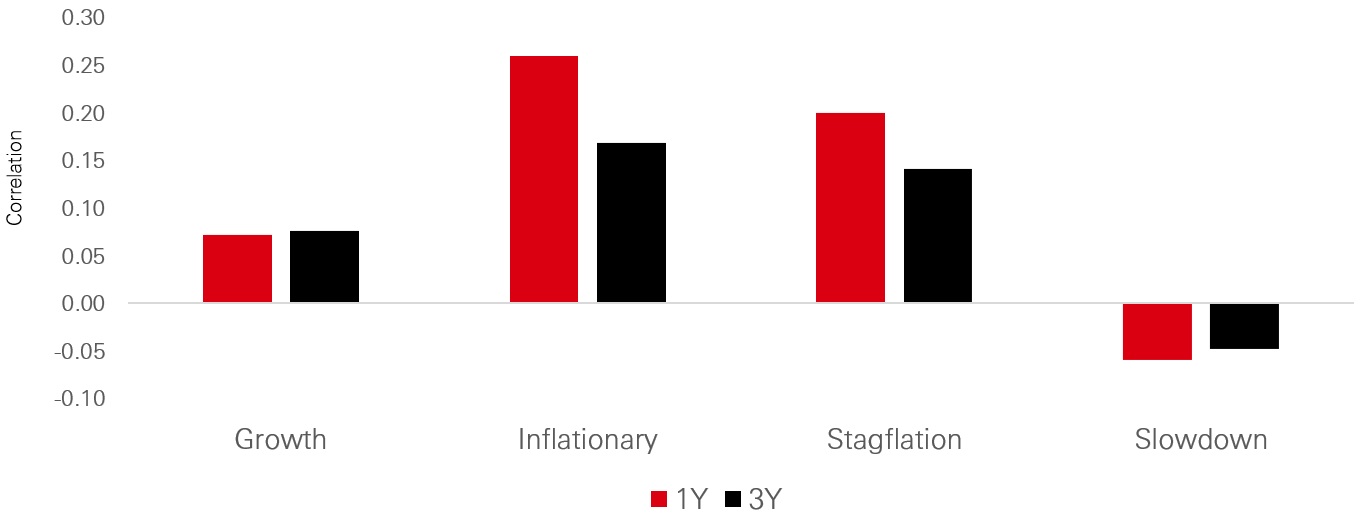
From a multi-asset perspective persistent inflation and higher interest rates require investors to rethink how portfolios are constructed. One of the biggest challenges in a higher inflation regime is the weakening of the traditional diversification benefits between equities and bonds. As inflation rises, the correlation between these asset classes tends to increase, reducing the effectiveness of the classic balanced portfolio, while overall market volatility also rises, particularly during stagflationary environments.
Click the image to enlarge
When looking at market returns, equities and conventional fixed income can face headwinds in real terms when inflation remains elevated. In contrast, assets linked more closely to the real economy, such as listed infrastructure, property and commodities, have historically demonstrated greater resilience, benefiting from inflation-linked revenues, pricing power or direct exposure to rising commodity prices. Inflation-linked bonds can also play an important role, although investors should remain mindful of duration risk, with shorter-dated inflation-linked exposure often offering more effective protection when interest rates are rising. Finally, liquid alternative strategies, such as trend-following approaches, can provide diversification through different market regimes by relying less on traditional equity and bond market relationships.
European Equities
Pricing Power Over Hope: Winning in an Inflation Regime
Summary
- Inflation isn’t a blanket equity hedge: Real returns can disappoint as higher costs and valuation pressure (rates/risk premia) offset nominal earnings growth, so sector and stock selection matters most
- Back pricing power and quality: Prioritise companies that can pass through costs and protect margins, delivering resilient cash flows and sustainable returns on capital
- Stay disciplined on price and income: Favour attractively valued names and reliable dividend growers, which may be better positioned as discount rates and equity risk premia remain elevated
Pricing Power, Margins and Valuations
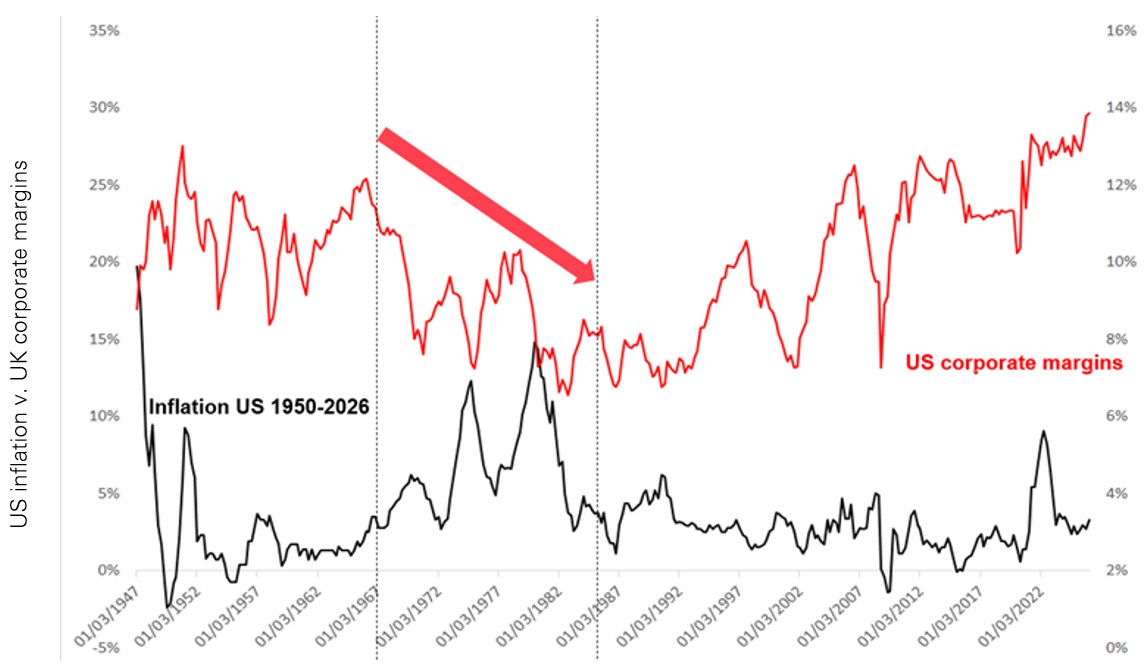
The widely held assumption that equities automatically provide an effective hedge against inflation comes with mixed evidence. While company revenues and dividends may rise in nominal terms as prices increase, history suggests that periods of sustained inflation have not necessarily translated into strong real equity returns. Looking back to the high inflation environment of the 1970s, although nominal earnings growth remained relatively resilient, much of this was offset by higher costs and margin compression, leaving real earnings growth close to zero.
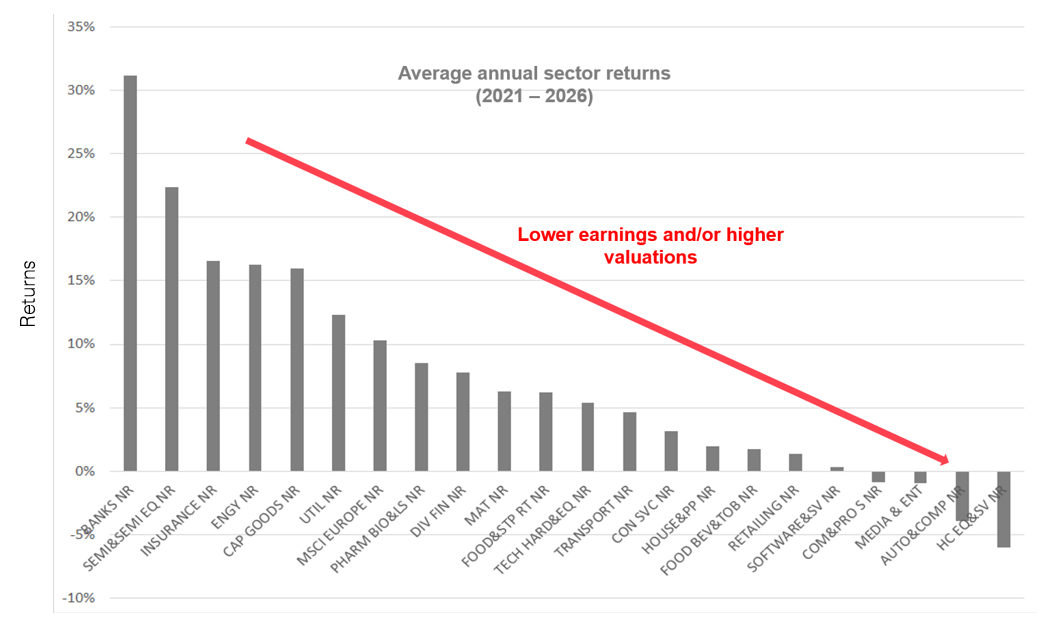
Equity returns are driven by three key factors: earnings growth, dividend income and changes in the equity risk premium. Persistent inflation can affect each of these differently. Companies with limited pricing power may struggle to pass higher input costs on to customers, resulting in lower margins and weaker returns on capital. At the same time, higher interest rates increase the attractiveness of risk-free assets, placing pressure on equity valuations as investors demand higher dividend yields and a greater equity risk premium to compensate for increased uncertainty.
Click the image to enlarge
Not all sectors are affected equally. Businesses positioned earlier in the supply chain, including industrial and commodity-related companies, have historically been better able to preserve profitability, while more consumer-facing sectors have often experienced greater margin pressure. More recently, sectors such as European banks have benefited from higher interest rates through improved net interest margins, illustrating how inflationary environments can create both winners and losers.
The key to investing successfully in a higher inflation regime lies not in treating equities as a broad inflation hedge, but in identifying companies with durable pricing power, resilient profitability and attractive valuations. In an environment where inflation uncertainty remains elevated, businesses capable of sustaining margins, generating reliable cash flows and paying competitive dividends are likely to be better positioned than the broader market.
Global Equities
Pricing Power: The Inflation Shield for Margins
Summary
- Quality: Prioritise pricing power, companies with durable competitive advantages that can defend margins as costs rise
- Dynamism: Favour strong management teams and businesses with operational flexibility to adapt pricing, products and cost bases as inflation conditions change
- Robustness: Look beyond headline revenue/earnings uplift and focus on free cash flow durability, returns on capital, and the ability to grow dividends in real terms over time
Pricing Power and Quality: Protecting Margins in Inflation
Looking at the inflation challenge from a bottom-up perspective, the key investment question is not whether inflation lifts company revenues, but whether businesses can continue to generate attractive returns when costs rise persistently. Working with the themes of earnings quality, valuation discipline and sustainable income, the defining characteristic of a resilient business is pricing power, the ability to protect margins by passing higher costs on to customers without damaging demand. This pricing power can arise from a number of competitive advantages, including strong brands and market share, intellectual property, a favourable position within the value chain, or significant purchasing power over suppliers. Together, these characteristics help companies maintain returns on capital and generate consistent cash flows despite inflationary pressures.
Click the image to enlarge
Source: HSBC Asset Management, Bloomberg, June 2026.
However, pricing power alone is not enough. It is important for management quality and the strategic flexibility to respond to changing cost environments. Companies that can optimise their cost base, redesign products, adjust pricing structures or use temporary cost absorption to strengthen competitive positioning are often better placed to preserve profitability over the long term. Rather than assuming inflation will naturally translate into higher earnings, the emphasis should be on identifying businesses capable of sustaining margins and free cash flow through multiple economic cycles.
For long-term investors, resilience comes from owning companies with durable competitive advantages and disciplined capital allocation. These are the businesses most likely to continue growing earnings and dividends in real terms, regardless of the inflation backdrop.
Inflation-Linked Bonds
Real Return Defence: The Role of Linkers
Summary
- Protect purchasing power: Use inflation-linked bonds alongside conventional government bonds to help preserve real wealth when inflation remains elevated, as coupons and principal adjust with inflation
- Watch breakevens (with nuance): Monitor breakeven inflation as a timely gauge of market inflation expectations; while recognising it also embeds risk premia and liquidity effects (so it isn’t a pure forecast)
- Deploy by regime: Position inflation-linked bonds strategically, they tend to outperform when inflation expectations rise or inflation surprises to the upside but can lag nominal government bonds in recessions/deflationary shocks when inflation expectations fall
Protecting Real Returns
Inflation-linked bonds can play an important role in helping investors preserve purchasing power when inflation remains elevated. Unlike conventional government bonds, where coupons and principal are fixed in nominal terms, inflation-linked bonds adjust both their coupon payments and principal value in line with inflation. As a result, they are designed to deliver a real return, making them a valuable tool for managing inflation risk within fixed income portfolios.
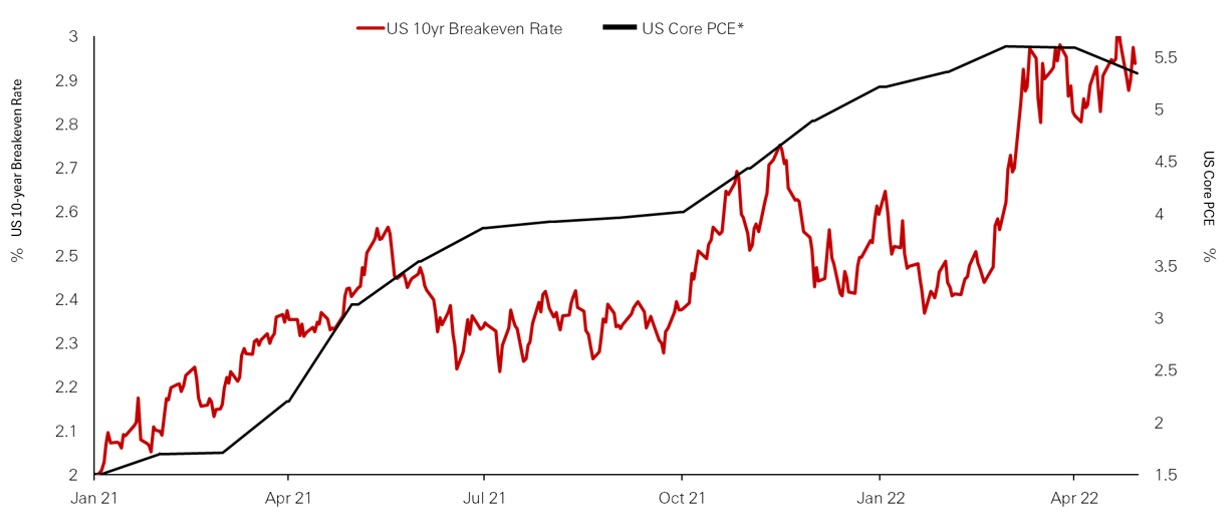
A key concept in understanding the asset class is the breakeven inflation rate, the difference in yield between a conventional government bond and an equivalent inflation-linked bond. This represents the average rate of inflation at which an investor would be indifferent between holding the two securities. While breakeven rates provide a useful real-time measure of market inflation expectations, they are not a pure forecast, as they also reflect factors such as investor risk premia and market liquidity.
Looking at the post-pandemic inflation surge, inflation-linked bonds can outperform conventional government bonds when inflation expectations rise, as widening breakeven inflation rates help cushion the impact of rising yields. However, their relative performance depends on the broader macroeconomic environment. Inflation-linked bonds have historically performed best during periods of elevated inflation or stronger nominal growth, while conventional government bonds have tended to outperform during recessions or deflationary shocks, when inflation expectations decline.
Click the image to enlarge
Sources: HSBC Asset Management and Bloomberg as of February 2026. (*)Personal Consumption Expenditures Price Index, Excluding Food and Energy. The views expressed above were held at the time of preparation and are subject to change without notice.
With the global inflation-linked bond market now exceeding several trillion dollars and spanning both developed and emerging markets, the asset class has become an increasingly important component of the fixed income universe, offering investors a practical way to diversify nominal bond exposure and improve portfolio resilience in an uncertain inflation environment.
Securitised Credit
Asset Allocation benefits of adding Securitised Credit
Summary
- Income support in higher for longer: Securitised credit can enhance portfolio income via floating-rate coupons (often linked to SOFR/SONIA), meaning cashflows may rise as policy rates stay elevated
- Diversification within fixed income: Returns are driven more by underlying collateral performance and structure than by traditional duration or corporate fundamentals, adding a differentiated source of risk/return alongside government and corporate bonds
- Targeted risk with relative value opportunities: The tranche structure allows investors to focus on senior, credit-enhanced positions, while a global opportunity set can help capture valuation and rate differences across regions
Floating-Rate Income and Diversification
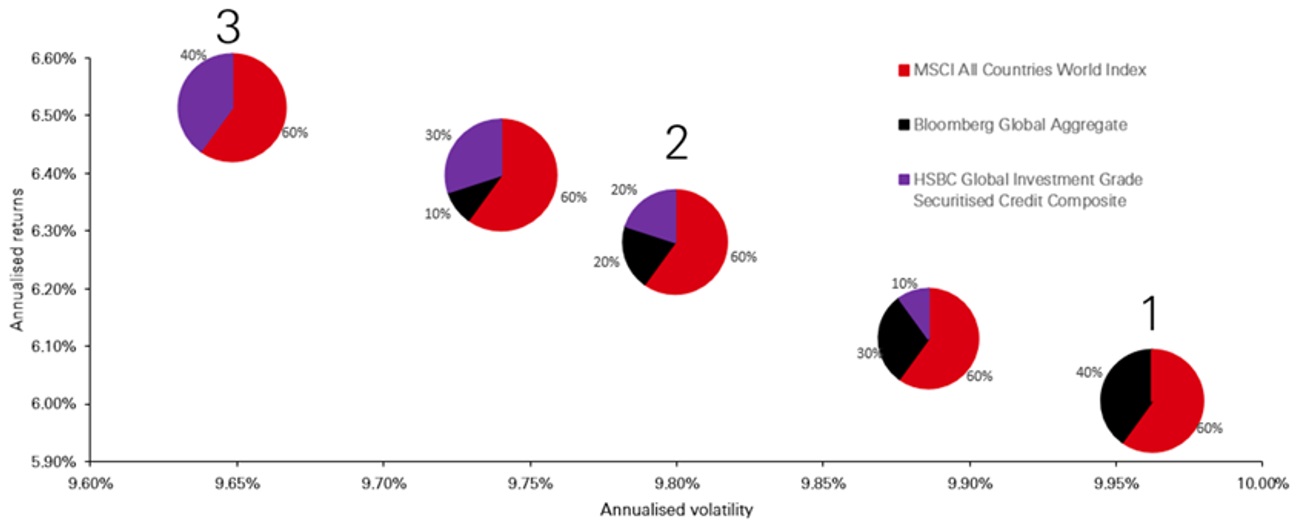
Securitised credit can play a meaningful role within fixed income portfolios in a higher-for-longer interest rate environment, acting as a complementary source of both income and diversification. Unlike traditional corporate bonds, it is backed by pools of underlying assets, such as residential and commercial mortgages, structured into tradable securities with different risk/return profiles. A key attraction is the combination of floating-rate income and relatively attractive credit spreads: many securitised instruments pay coupons linked to reference rates such as SOFR or SONIA, meaning income can increase as policy rates remain elevated, while spreads in several securitised sectors still compare favourably with similarly rated corporate credit.
Click the image to enlarge
The asset class can also diversify more traditional government and corporate bond exposure, with performance driven by collateral fundamentals and structural protections rather than purely by duration or corporate balance sheets. Importantly, the tranche-based structure allows investors to target senior positions with substantial credit enhancement, which can help limit downside risk if economic conditions deteriorate. With collateral often tied to real assets (including property), there may also be some additional support for credit quality in an inflationary backdrop. Finally, a global approach can help investors capture differences in regional rates and valuations, though disciplined security selection and an emphasis on senior tranches remain important, particularly if inflation becomes more extreme. As illustrated in the chart, increasing the allocation to investment grade securitised credit (funded from global aggregate bonds) is associated with higher annualised returns alongside slightly lower volatility in the portfolio mix shown.Listed Real Assets
Inflation Pass-Through Meets Rate Reality
Summary
- Prioritise inflation pass-through: Focus on listed infrastructure/real estate businesses with clear mechanisms to pass inflation through to end users (e.g., regulated tariffs, rent indexation, contractual price escalators), as this is the key driver of purchasing-power protection
- Balance cashflow uplift vs rate pressure: Treat listed real assets as long-duration exposures, higher inflation can lift cash flows, but rising discount rates can still compress valuations, so outcomes depend on the net of these two forces
- Be selective (especially across sub-sectors): Listed infrastructure has historically been more resilient than listed real estate in higher-inflation regimes due to more effective contractual/regulatory pass-through; active management and security selection matter because regulation, contract terms and business models drive wide dispersion
Inflation Pass-Through and Rate Sensitivity
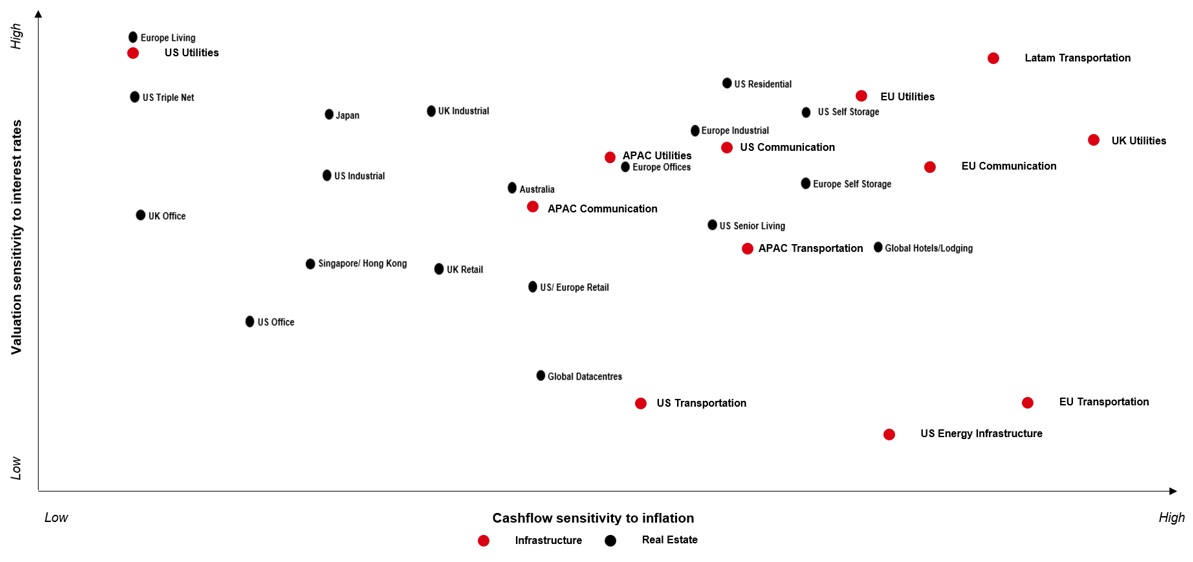
Listed infrastructure and listed real estate can both contribute to portfolio resilience in a higher-for-longer inflation environment, but they shouldn’t be viewed as a homogeneous “real assets” allocation. Their ability to preserve purchasing power depends largely on one critical characteristic: the ability to pass higher inflation through to customers via mechanisms such as rent increases, regulated tariffs or contractual price escalators.
However, inflation protection is only one side of the equation. Listed real assets are also long-duration investments, with valuations based on cash flows expected many years into the future. As inflation pushes interest rates higher, rising discount rates can place downward pressure on valuations, meaning performance reflects a balance between stronger cash flows from inflation pass-through and weaker valuations resulting from higher rates.
Click the image to enlarge
Looking across different inflation regimes since the early 2000s, listed infrastructure has generally demonstrated greater resilience than listed real estate during periods of elevated inflation, largely because contractual or regulated revenue frameworks allow inflation to be passed through more effectively and help offset the impact of rising rates. By contrast, listed real estate has historically performed best in environments of low and falling inflation, when declining interest rates support valuations. A key conclusion is that successful investing requires looking beyond broad labels, regulatory frameworks, contract structures, competitive dynamics and the duration profile of individual assets can materially influence performance, so active management and detailed security selection are important.
Inflation Resilience: Themes and Trade-offs
Building Inflation Aware Portfolios
Summary
- Real assets matter: Over the long run, real estate and energy equities have the most repeatable, evidence-backed resilience in inflationary periods, though outcomes depend on market and country exposure
- Factors beat forecasts: Inflationary episodes coupled with rising rates favours value stocks over long-duration growth stocks; the 2022 episode was a clear recent example, with value outperforming growth by around four times (in 2022). Quality and high dividend yield stocks tend to be resilient, while momentum stocks showed mixed results
- Defensive sectors help preserve capital: Consumer staples and utilities tend to combine pricing power with more defensive characteristics as purchasing power erodes. Defensive sectors can help to mitigate drawdown risk during inflationary episodes
Why Inflation Positioning is More Nuanced This Time
Despite inflation risk rising again across the US and Europe few investors have positioned for a more secular pickup in inflation still viewing it as a transitory phenomenon. In practice, there isn’t one perfect asset allocation construct that works in every inflationary regime, and outcomes are often driven by the source of the inflation and the policy response. 2022 is the cleanest reminder: inflation and aggressive rate hikes hit at the same time, and both equities and bonds sold off, making “simple” inflation playbooks less reliable and diversification harder to find.
Against that backdrop, we think it’s helpful to frame inflation resilience through practical themes that investors can use when considering portfolio allocations that have worked across inflationary regimes.
Real Assets remain the most traditional and evidence-backed hedge. Real estate, infrastructure and energy equities have historically offered the most consistent resilience when inflation runs hot, although real estate as an asset class can react in a more nuanced fashion depending on inflationary regime.
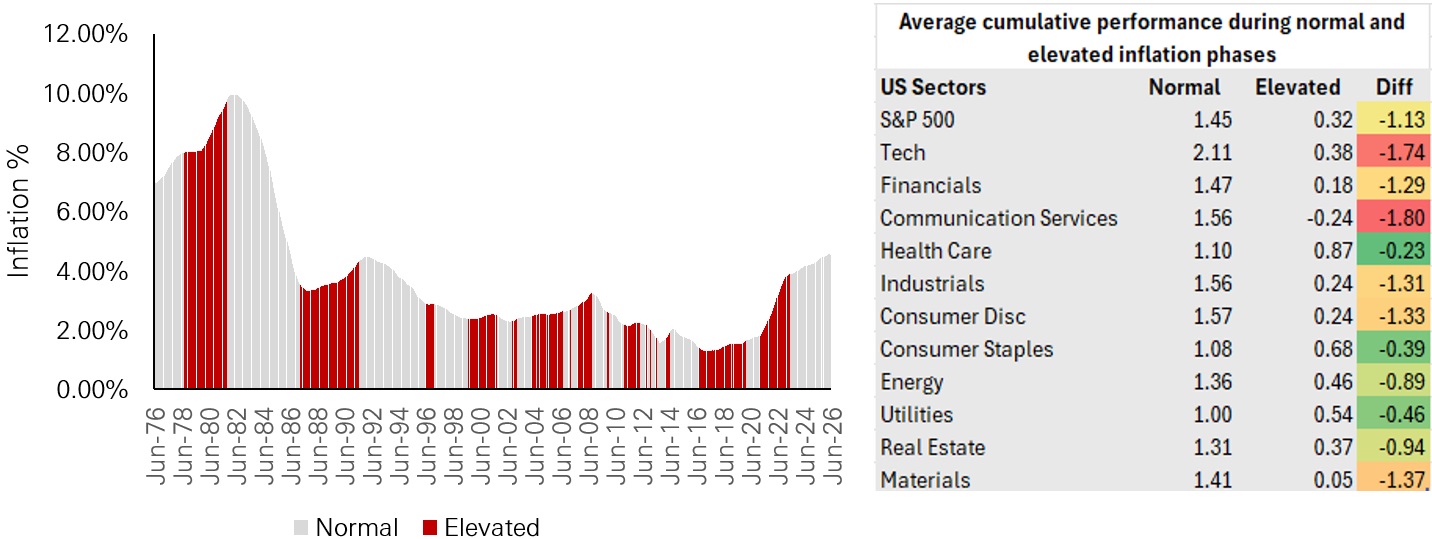
Inflationary periods often come with higher rates, and that tends to shift leadership within equities towards value. The post-Covid inflationary boom of 2022 provides the cleanest recent illustration of this dynamic, with growth materially lagging and value outperforming by close to four times. However, results can look different across regions as momentum and quality performed well in certain markets such as Japan and EM equities.
Click the image to enlarge
Points to consider for an inflation aware allocation:
- Global Real Estate ETFs can provide geographical diversification—particularly important in today’s environment, where inflation trends and rate hike trajectories vary by region
- Factor ETFs can provide direct exposure to specific factors. Investors may prefer a broad, global value approach or opt for region-/country-specific factor allocations
- Sectoral diversity in the portfolio: Investors can choose to take outright sector bets or build a more sector-diversified portfolio by allocating to markets with different sector compositions (for instance, the FTSE 100 is weighted towards traditional industries such as financials and energy compared to the S&P 500)
Defensive Positioning for Inflation Drawdowns
While inflation can reward the right exposures, it can also increase the risk of drawdowns through volatility, margin pressures, and shifting policy expectations. In that context, defensive and quality exposures can play a useful role as a source of capital preservation.
Sector positioning matters. As purchasing power erodes, consumers typically trim non-essential spending first, which is why utilities and consumer staples are often favoured over discretionary sectors in inflation-aware portfolios. These sectors tend to combine steadier demand with the potential for pricing power, offering a more defensive profile when inflation is persistent.
Emerging market dynamics: Whilst we have seen classic value plays provide encouragement in developed markets, we note that quality is the most consistent stabiliser across regimes in EM, momentum is a structural risk here as it tends to lead in good times and lag in bad times suggesting a quality led exposure could be a useful downside stabiliser.
An inflation-aware equity sleeve can be framed around three building blocks: targeted exposure to real assets (notably real estate and energy), a tilt towards value, and an allocation to defensive sectors such as utilities and consumer staples, complemented where appropriate by a focus on quality to help manage drawdown risk.
Source: HSBC Asset Management, data as of July 2026.
Past performance does not predict future returns. The views expressed above were held at the time of preparation and are subject to change without notice. Any forecast, projection or target where provided is indicative only and is not guaranteed in any way. HSBC Asset Management accepts no liability for any failure to meet such forecast, projection or target. Diversification does not ensure a profit or protect against loss. This information shouldn’t be considered as an investment advice.
Important information
For Professional Clients and intermediaries within countries and territories set out below; and for Institutional Investors and Financial Advisors in the US. This document should not be distributed to or relied upon by Retail clients/investors.
The value of investments and the income from them can go down as well as up and investors may not get back the amount originally invested. The performance figures contained in this document relate to past performance, which should not be seen as an indication of future returns. Future returns will depend, inter alia, on market conditions, investment manager’s skill, risk level and fees. Where overseas investments are held the rate of currency exchange may cause the value of such investments to go down as well as up. Investments in emerging markets are by their nature higher risk and potentially more volatile than those inherent in some established markets. Economies in emerging markets generally are heavily dependent upon international trade and, accordingly, have been and may continue to be affected adversely by trade barriers, exchange controls, managed adjustments in relative currency values and other protectionist measures imposed or negotiated by the countries and territories with which they trade. These economies also have been and may continue to be affected adversely by economic conditions in the countries and territories in which they trade.
The contents of this document may not be reproduced or further distributed to any person or entity, whether in whole or in part, for any purpose. All non-authorised reproduction or use of this document will be the responsibility of the user and may lead to legal proceedings. The material contained in this document is for general information purposes only and does not constitute advice or a recommendation to buy or sell investments. Some of the statements contained in this document may be considered forward looking statements which provide current expectations or forecasts of future events. Such forward looking statements are not guarantees of future performance or events and involve risks and uncertainties. Actual results may differ materially from those described in such forward-looking statements as a result of various factors. We do not undertake any obligation to update the forward-looking statements contained herein, or to update the reasons why actual results could differ from those projected in the forward-looking statements. This document has no contractual value and is not by any means intended as a solicitation, nor a recommendation for the purchase or sale of any financial instrument in any jurisdiction in which such an offer is not lawful. The views and opinions expressed herein are those of HSBC Asset Management at the time of preparation and are subject to change at any time. These views may not necessarily indicate current portfolios' composition. Individual portfolios managed by HSBC Asset Management primarily reflect individual clients' objectives, risk preferences, time horizon, and market liquidity. Foreign and emerging markets: investments in foreign markets involve risks such as currency rate fluctuations, potential differences in accounting and taxation policies, as well as possible political, economic, and market risks. These risks are heightened for investments in emerging markets which are also subject to greater illiquidity and volatility than developed foreign markets. This commentary is for information purposes only. It is a marketing communication and does not constitute investment advice or a recommendation to any reader of this content to buy or sell investments nor should it be regarded as investment research. It has not been prepared in accordance with legal requirements designed to promote the independence of investment research and is not subject to any prohibition on dealing ahead of its dissemination. This document is not contractually binding nor are we required to provide this to you by any legislative provision.
All data from HSBC Asset Management unless otherwise specified. Any third-party information has been obtained from sources we believe to be reliable, but which we have not independently verified.
This document provides a high level overview of the recent economic environment. It is for marketing purposes and does not constitute investment research, investment advice nor a recommendation to any reader of this content to buy or sell investments. It has not been prepared in accordance with legal requirements designed to promote the independence of investment research and is not subject to any prohibition on dealing ahead of its dissemination.
HSBC Asset Management is the brand name for the asset management business of HSBC Group, which includes the investment activities that may be provided through our local regulated entities. HSBC Asset Management is a group of companies in many countries and territories throughout the world that are engaged in investment advisory and fund management activities, which are ultimately owned by HSBC Holdings Plc. (HSBC Group).
- In Australia, this document is issued by HSBC Bank Australia Limited ABN 48 006 434 162, AFSL 232595, for HSBC Global Asset Management (Hong Kong) Limited ARBN 132 834 149 and HSBC Global Asset Management (UK) Limited ARBN 633 929 718. This document is for institutional investors only and is not available for distribution to retail clients (as defined under the Corporations Act). HSBC Global Asset Management (Hong Kong) Limited and HSBC Global Asset Management (UK) Limited are exempt from the requirement to hold an Australian financial services license under the Corporations Act in respect of the financial services they provide. HSBC Global Asset Management (Hong Kong) Limited is regulated by the Securities and Futures Commission of Hong Kong under the Hong Kong laws, which differ from Australian laws. HSBC Global Asset Management (UK) Limited is regulated by the Financial Conduct Authority of the United Kingdom and, for the avoidance of doubt, includes the Financial Services Authority of the United Kingdom as it was previously known before 1 April 2013, under the laws of the United Kingdom, which differ from Australian laws;
- In Bermuda, this document is issued by HSBC Global Asset Management (Bermuda) Limited, of 37 Front Street, Hamilton, Bermuda which is licensed to conduct investment business by the Bermuda Monetary Authority;
- In France, Belgium, Netherlands, Luxembourg, Portugal, Greece, Finland, Norway, Denmark, Spain and Sweden this document is issued by HSBC Global Asset Management (France), a Portfolio Management Company authorised by the French regulatory authority AMF (no. GP99026);
- In Germany, this document is issued by HSBC Global Asset Management (Deutschland) GmbH which is regulated by BaFin (German clients) respective by the Austrian Financial Market Supervision FMA (Austrian clients);
- In Hong Kong, this document is issued by HSBC Global Asset Management (Hong Kong) Limited, which is regulated by the Securities and Futures Commission. This content has not been reviewed by the Securities and Futures Commission;
- In India, this document is issued by HSBC Asset Management (India) Pvt Ltd. which is regulated by the Securities and Exchange Board of India;
- In Italy, this document is issued by HSBC Global Asset Management (France), a Portfolio Management Company authorised by the French regulatory authority AMF (no. GP99026), through its Italian branch, regulated by Banca d’Italia and Commissione Nazionale per le Società e la Borsa (Consob);
- In Japan, this document is issued by HSBC Asset Management (Japan) Ltd (JRN 3010001124868), regulated by the Financial Services Agency;
- In Malta, this document is issued by HSBC Global Asset Management (Malta) Limited which is regulated and licensed to conduct Investment Services by the Malta Financial Services Authority under the Investment Services Act;
- In Mexico, this document is issued by HSBC Global Asset Management (Mexico), SA de CV, Sociedad Operadora de Fondos de Inversión, Grupo Financiero HSBC which is regulated by Comisión Nacional Bancaria y de Valores;
- In the United Arab Emirates, this document is issued by HSBC Investment Funds (Luxembourg) S.A. – Dubai Branch (Level 20, HSBC Tower, PO Box 66, Downtown Dubai, United Arab Emirates) regulated by the Capital Market Authority (CMA) in the UAE to conduct investment fund management, portfolios management, fund administration activities (CMA Category 2 license No.20200000336) and promotion activities (CMA Category 5 license No.20200000327).
- In the United Arab Emirates, this document is issued by HSBC Global Asset Management MENA, a unit within HSBC Bank Middle East Limited, U.A.E Branch, PO Box 66 Dubai, UAE, regulated by the Central Bank of the U.A.E. and the Capital Market Authority in the UAE under CMA license number 602004 for the purpose of this promotion and lead regulated by the Dubai Financial Services Authority. HSBC Bank Middle East Limited is a member of the HSBC Group and HSBC Global Asset Management MENA are marketing the relevant product only in a sub-distributing capacity on a principal-to-principal basis. HSBC Global Asset Management MENA may not be licensed under the laws of the recipient’s country of residence and therefore may not be subject to supervision of the local regulator in the recipient’s country of residence. One of more of the products and services of the manufacturer may not have been approved by or registered with the local regulator and the assets may be booked outside of the recipient’s country of residence.
- In Singapore, this document is issued by HSBC Global Asset Management (Singapore) Limited, which is regulated by the Monetary Authority of Singapore. The content in the document/video has not been reviewed by the Monetary Authority of Singapore;
- In Switzerland, this document is issued by HSBC Global Asset Management (Switzerland) AG. This document is intended for professional investor use only. For opting in and opting out according to FinSA, please refer to our website; if you wish to change your client categorization, please inform us. HSBC Global Asset Management (Switzerland) AG having its registered office at Gartenstrasse 26, PO Box, CH-8002 Zurich has a licence as an asset manager of collective investment schemes and as a representative of foreign collective investment schemes. Disputes regarding legal claims between the Client and HSBC Global Asset Management (Switzerland) AG can be settled by an ombudsman in mediation proceedings. HSBC Global Asset Management (Switzerland) AG is affiliated to the ombudsman FINOS having its registered address at Talstrasse 20, 8001 Zurich. There are general risks associated with financial instruments, please refer to the Swiss Banking Association (“SBA”) Brochure “Risks Involved in Trading in Financial Instruments”;
- In Taiwan, this document is issued by HSBC Global Asset Management (Taiwan) Limited which is regulated by the Financial Supervisory Commission R.O.C. (Taiwan);
- In Turkiye, this document is issued by HSBC Asset Management A.S. Turkiye (AMTU) which is regulated by Capital Markets Board of Turkiye. Any information here is not intended to distribute in any jurisdiction where AMTU does not have a right to. Any views here should not be perceived as investment advice, product/service offer and/or promise of income. Information given here might not be suitable for all investors and investors should be giving their own independent decisions. The investment information, comments and advice given herein are not part of investment advice activity. Investment advice services are provided by authorized institutions to persons and entities privately by considering their risk and return preferences, whereas the comments and advice included herein are of a general nature. Therefore, they may not fit your financial situation and risk and return preferences. For this reason, making an investment decision only by relying on the information given herein may not give rise to results that fit your expectations.
- In the UK, this document is issued by HSBC Global Asset Management (UK) Limited, which is authorised and regulated by the Financial Conduct Authority;
- In the US, this document is issued by HSBC Securities (USA) Inc., an HSBC broker dealer registered in the US with the Securities and Exchange Commission under the Securities Exchange Act of 1934. HSBC Securities (USA) Inc. is also a member of NYSE/FINRA/SIPC. HSBC Securities (USA) Inc. is not authorized by or registered with any other non-US regulatory authority. The contents of this document are confidential and may not be reproduced or further distributed to any person or entity, whether in whole or in part, for any purpose without prior written permission.
- In Chile, operations by HSBC's headquarters or other offices of this bank located abroad are not subject to Chilean inspections or regulations and are not covered by warranty of the Chilean state. Obtain information about the state guarantee to deposits at your bank or on www.cmfchile.cl;
- In Colombia, HSBC Bank USA NA has an authorized representative by the Superintendencia Financiera de Colombia (SFC) whereby its activities conform to the General Legal Financial System. SFC has not reviewed the information provided to the investor. This document is for the exclusive use of institutional investors in Colombia and is not for public distribution;
- In Costa Rica, the Fund and any other products or services referenced in this document are not registered with the Superintendencia General de Valores (“SUGEVAL”) and no regulator or government authority has reviewed this document, or the merits of the products and services referenced herein. This document is directed at and intended for institutional investors only.
- In Peru, HSBC Bank USA NA has an authorized representative by the Superintendencia de Banca y Seguros in Perú whereby its activities conform to the General Legal Financial System - Law No. 26702. Funds have not been registered before the Superintendencia del Mercado de Valores (SMV) and are being placed by means of a private offer. SMV has not reviewed the information provided to the investor. This document is for the exclusive use of institutional investors in Perú and is not for public distribution;
- In Uruguay, operations by HSBC's headquarters or other offices of this bank located abroad are not subject to Uruguayan inspections or regulations and are not covered by warranty of the Uruguayan state. Further information may be obtained about the state guarantee to deposits at your bank or on www.bcu.gub.uy.
Copyright © HSBC Global Asset Management Limited 2026. All rights reserved. No part of this publication may be reproduced, stored in a retrieval system, or transmitted, on any form or by any means, electronic, mechanical, photocopying, recording, or otherwise, without the prior written permission of HSBC Asset Management.
Content ID: D076030_v3.0; Expiry Date: 30.06.2027