

Securitised Credit
Synopsis
- Collateralised Loan Obligations (CLOs) are securitisations of corporate loans. CLOs are floating rate securities, providing investors with attractive levels of income. CLOs are performing strongly in the current macroeconomic environment
- We believe broadly syndicated Loan (BSL) Collateralised Loan Obligations (CLOs) sponsored by high-quality CLO managers offer attractive risk-adjusted returns and are our preferred investment compared to mid-market loan CLOs, Private Credit CLOs and commercial real estate loan CLOs
- Manager and Security Selection is key in this sector. Credit enhancement behind the senior tranches provides investors with a significant cushion against collateral losses and senior tranches are best placed to navigate any market volatility
- Tranches allow investors to choose their level of risk, along with where they want to allocate across senior, subordinated and equity tranches
- CLOs offer a spread premium over similarly rated traditional fixed income corporates and provide diversification benefits in a fixed income portfolio given their unique cash flow profile and structure
- Demand for the asset class, as demonstrated by the strong CLO issuance in recent years, was well absorbed by the market and bodes well for the sector
What is a CLO?
A CLO is a special purpose vehicle (SPV) backed by a pool of loans – typically leveraged loans that are issued to corporate entities. As of end April 2026, CLOs represent ~34 per cent (c.USD1.4tn) of the distributed Securitised Credit market.
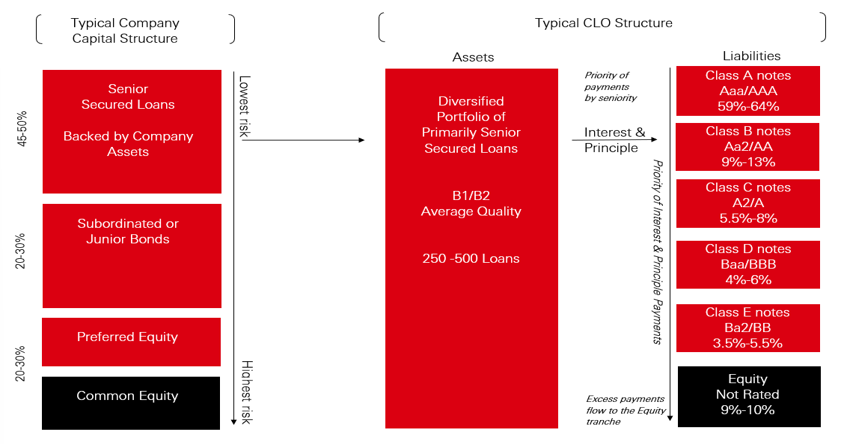
The below chart shows an illustrative structure of a CLO including the number of underlying leveraged loans to private companies, the different levels of risk comprising the CLO and the order of payments from these loans to the investors in different CLO tranches.
Typical Broadly Syndicated CLO Structures
Click the image to enlarge
Source: HSBC Asset Management, LCD Global Review – US/Europe 2Q 2018 and LCD Loan Primer “Syndicated Loans: The Market and the Mechanics – 2017”
CLOs can offer investors diversification benefits versus equivalent rated corporate bonds due to lower correlations but also offer much more…
- Floating rate: CLO securities pay investors a spread above a benchmark such as SOFR or EURIBOR. The spread is larger than for comparably rated corporate bonds and provide additional yield. The floating rate aspect means that elevated base rates provide attractive levels of income and, while the yield curve remains flat, significant benefit over longer duration bonds. The fact that the coupons change with rates means that this yield is paid as current running income
- Manager selection: Choosing the right CLO manager is fundamental to CLO investing. The CLO manager selects the different loans across various sectors that make up the CLO itself. Therefore, it is crucial that the loans selected are in the right sectors, are of high credit quality and are in full compliance with the terms/triggers and criteria of the CLO structure
CLOs are actively managed. An active CLO manager has the ability to spot warning signs in individual loans and sectors early and move the portfolio to lower risk sectors. Extracting the best opportunities allows the CLO manager to enrich risk-adjusted returns for investors.
It is our opinion that top tier institutional quality CLO managers are more likely to achieve this by selecting a diversified portfolio of high-quality loans across market sectors. - Tranches: Tranches create a capital structure within the CLO, allowing investors to allocate based upon their risk appetite across senior, subordinated and equity securities. Senior tranches receive principal and interest payments from the CLO first with subordinated and equity tranches receiving their payments only once the senior tranche above them has been paid. The lower tranches are also the first to absorb any losses realised within the structure
- Credit enhancement: The structural features of credit enhancement may provide an extra layer of protection in addition to the underlying collateral security before investors begin to suffer losses. Credit enhancement at the top tranches of the securitisation are higher now than in previous cycles. These include cash reserve funds, overcollateralisation (where the value of collateral exceeds the loan value) and excess spread (amount paid by the loans inside the CLO exceeds amount paid to debt investors and is available to cover any loan losses first. Remaining income after losses is paid to the CLO equity)
- Risk retention: Regulatory changes have symbiotically aligned issuer and investor interests in the CLO market, providing further protection to CLO investors. EU Risk Retention regulation forces CLO managers distributing in Europe to retain 5 per cent of the securitisation on the CLO manager balance sheet (skin in the game)
- Prudent management: Typically, the CLO managers take exposure to the lowest quality equity tranche of a securitisation and are restricted to a maximum of 7.5 per cent allocation to CCC rated debt (with any excess restricting returns to the equity tranche), further incentivising prudent management of the underlying assets
Size matters
When it comes to the CLO sector, size matters with regards to the corporates backing the loans, the CLO manager, and the syndication of the CLOs.
- Corporates: Typically, the underlying assets in BSL CLOs we invest in are mostly Senior Secured/First Lien corporate loans (this means the CLO manager has a priority claim on the secured assets in event of a bankruptcy). These loans are all from established corporates that typically have an EBITDA greater than USD200mn. A BSL CLO holds between 250–500 corporate loans
- Type of CLO manager: As mentioned above, repeat-issue, top tier institutional quality CLO managers with experience in the market are most likely to outperform. Given this, it should come as no surprise that we utilise our enhanced due diligence procedure and our team’s length of time in the market to select the better performing managers. With roughly 150 CLO managers in the US CLO market, we only invest with a small selection of managers that we believe can unlock the opportunities and navigate the pitfalls in this asset class
- Broadly syndicated loans (BSL): CLOs at a broader level can be segregated into different types based on the underlying loan collateral. The main types are broadly syndicated loans (i.e. big loans to big companies, with many large institutions as investors behind the loan), smaller mid-market leveraged loans, Private Credit loans and commercial real estate (CRE) CLOs. We only invest in CLOs backed by broadly syndicated loans and therefore avoid the higher credit risk associated with smaller mid-market firms Private Credit loans and nuances involved with commercial real estate CLOs. Indeed, mid-market, Private Credit and CRE CLOs are already showing signs of distress. The size of the broadly syndicated loans market also facilitates sectoral diversity within the CLO portfolio, which we believe makes it the most attractive segment.
Selecting a manager with the right credit resources to make the best loan selection and manage the loan portfolio during the term of the CLO is critical: when interest rates are high (attractive coupons for investors), defaults and loan loss in the CLO might tick up because of the high borrowing costs for the underlying companies.
Loan defaults have ticked up slightly from historically low levels in 2021 but remain well below the long run average of around 3 per cent. Year-to-date it is currently 1.46 per cent and 1.42 per cent in US and Europe respectively as of end March. Along-side our allocation to higher rated tranches (i.e. senior securities), our approach to CLO investing seems well suited to manage any potential increases in defaults as well as any possible credit deterioration within the underlying CLO collateral.
Navigating the pitfalls
During Q1 2026, concerns arose over private credit and specifically loans in private credit portfolios to Software companies, whose business could be interrupted by the advance of AI technology.
Unlike private credit, investing in public bonds with public ratings with a CLO manager means avoiding direct exposure to the sector but also an added layer of protection through credit enhancement which is not present in funds of private credit loans.
The importance of investing with top tier CLO managers and BSL in particular was highlighted during this period. Top tier managers are able to spot the warning signs in sectors early and dynamically move the portfolio of loans. The exposure to software loans in the BSL market was also to those more established and larger companies who are well placed to manage and evolve with the advance of AI technology.
What makes us so sure?
In our three Securitised Credit funds (Investment Grade, Flexible and High Yield), as of 31 March 2026, we had around 8-9 per cent exposure to software loans through the CLOs we invest in. For the leveraged loan market as a whole ,anecdotally, exposure was 15 per cent in the US and 10 per cent in Europe and for the Private credit market exposure to Software companies was 20 per cent-25 per cent.
We stress tested our CLOs with a crisis stress- defaulting 75 per cent of all software loans with nil recovery in a short time in addition to the current market default rate (1.5 per cent annual default).
This would represent the worst possible outcome for the technology sector. It also assumes no benefit to the actions of the CLO managers to manage the portfolio of loans. Despite this and as can be seen in the table below, both the Investment Grade and Flexible fund would not incur a loss. The High Yield fund would incur a small 1 per cent loss.
| HY BB | Flex (BBB) | IG (AA) | |
|---|---|---|---|
| Avg CLO exposure to software | 9.0% | 8.4% | 8.1% |
| Max CLO exposure to software | 13.1% | 14.4% | 14.4% |
| Min CLO exposure to software | 3.3% | 0.4% | 0.4% |
| Avg MVOC | 106.4% | 114.0% | 131.3% |
| Loss to the fund in extreme stress | $1.0m (1.0%) | 0 | 0 |
| No. deals with stress loss to a tranche | 2 | 0 | 0 |
| Lowest remaining C/E if no losses | 2.0% | 8.3% | 18.6% |
| Potential for downgrade | Low | Low | None |
Sources: Bloomberg/HSBC Asset Management as at 31 March 2026 and subject to change.
The road ahead for CLOs in 2026 and what can we expect from them in an uncertain Macro-Environment:
The situation in Iran and trade tensions is creating a stagflation problem. Global central banks have had to pivot from moderate rate cuts at the beginning of the year to potential rate hikes. This is because inflation has been kept elevated by repeated supply shocks—especially higher energy prices—alongside pockets of resilience in wages and activity. Against this backdrop, interest rates are expected to stay higher for longer. This has been supportive for income from floating rate CLOs which continue to offer attractive current coupons.
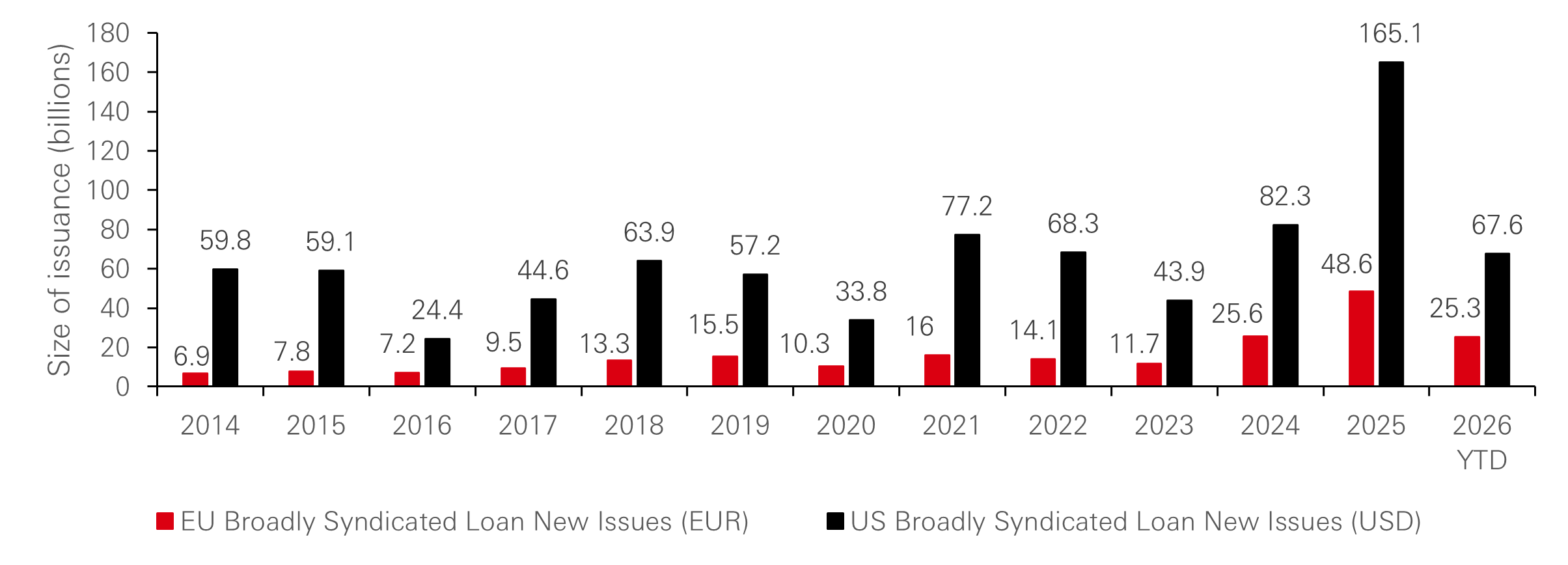
The CLO market has seen record issuance in 2024 and 2025. Strong issuance with tight spreads continued heading into 2026, followed by a slow down in issuance activities and spread widening as a result of geopolitical uncertainty. Despite the brief interruption in March, market activities have picked up again since April. 2026 issuance is expected to remain strong, albeit likely to be shy of 2025 levels.
Market demand is expected to remain strong, especially for high quality paper, with institutional clients and investment banks continuing to make up the lion share of investment.
Click the image to enlarge
Source: HSBC Asset Management, Barclays as at 30 April 2026. The views expressed above were held at the time of preparation and are subject to change without notice. Past performance does not predict future returns.
Despite default rates ticking up from historical lows, we are not seeing any signs of systemic risk, and they remain well below historical averages. Even if default rates were to increase to longer term averages, this is far from a concern, given that we continue to invest solely in broadly syndicated CLOs, with a strong focus on institutional quality, repeat-issue CLO managers (we only invest with the top 15 out of 150 managers).
In this environment of uncertain future interest rates paths, CLOs are an attractive asset class:
- Inflation is a key concern and if it remains sticky, interest rates will either stay at currently elevated levels or central banks will have to hike further. In this environment, income generation from CLOs would be strong
- High quality CLOs dynamically selected by Institutional quality CLO managers could also be best placed to manage any growth concerns, with returns being enhanced by capital appreciation through spread tightening
- In the case that we do see interest rate cuts; it is unlikely we go back to the “lower for longer” levels seen previously. With interest rates at more neutral levels, CLOs will continue to generate high levels of income and returns would most likely be complemented with spread tightening due to favourable credit conditions
- Spreads on CLOs will always be higher than traditional corporates due to the complexity premiums on offer when evaluating pools of loans. These provide opportunities for investors to source high quality CLOs whilst earning a spread premium
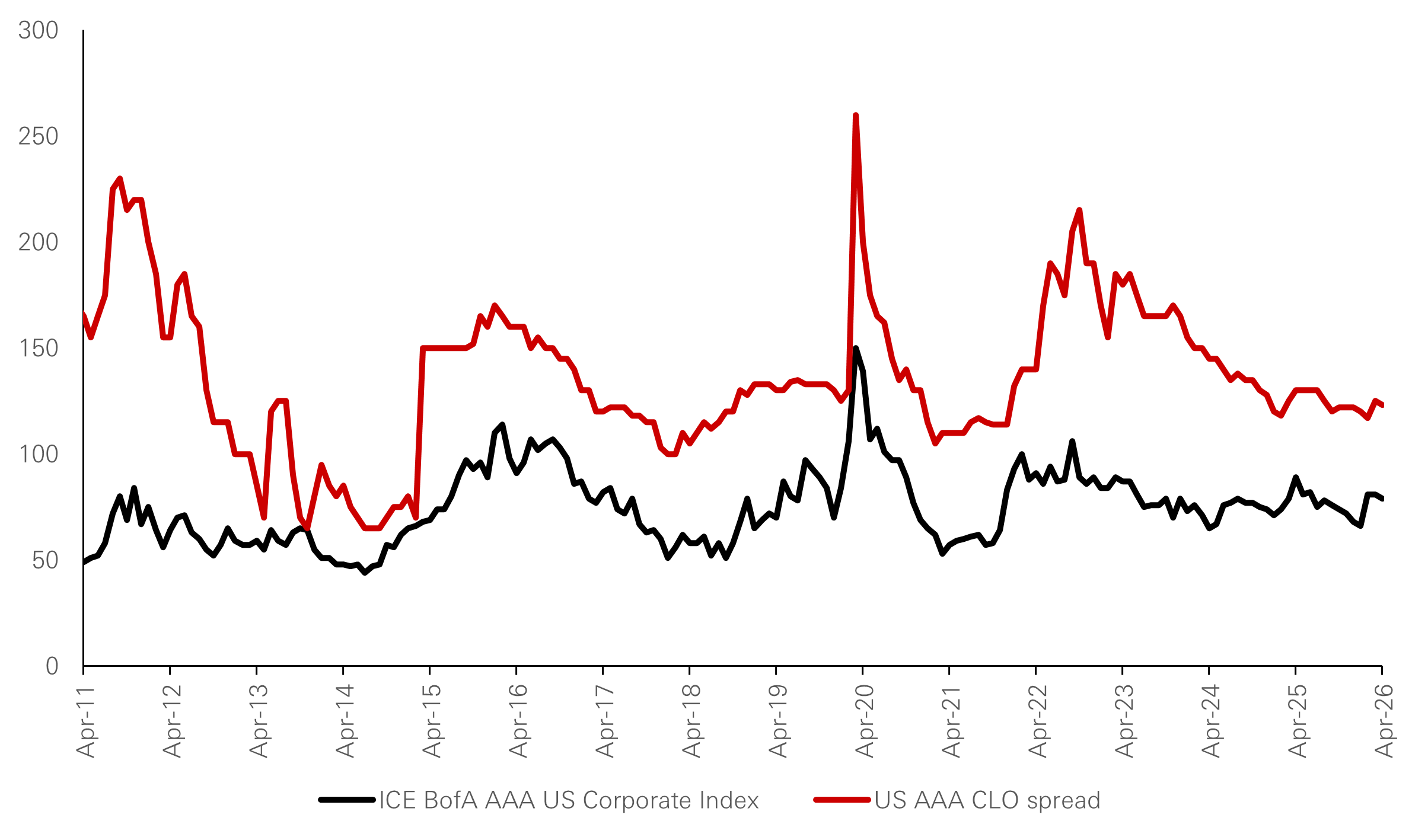
When we look at CLO spreads, they remain wide of their historic normal trading tights. The same cannot be said for traditional corporates which continue to be tight.
CLOs will always provide a spread pick-up when compared to equivalent rated corporate bonds (which are at historical spread tights). One can argue from an asset allocation perspective that high quality CLOs are more attractive than high quality corporate bonds at this point in the cycle.
In fact, as can be seen below, in all instances within the below chart, AAA US CLOs offer a wider spread than AAA US corporate bonds, highlighting their attractiveness.
CLO spreads offer real premiums and can tighten further
Click the image to enlarge
Source: Bloomberg, JP Morgan, HSBC Asset Management, as at 30 April 2026.
Conclusion
CLOs continue to be an attractive proposition, and we believe they should be front and centre in the minds of institutional investors. There is a yield pick up on offer from the complexity of CLOs, which when added to elevated base rates provides strong income. CLOs have low correlation to traditional fixed income corporates given its unique cash flow profile making it a good mixer in fixed income portfolios. There is the opportunity for further returns through spread compression. However, extracting the returns and diversification benefits will hinge on manager selection which is of paramount importance. There is strong demand for the asset class as evidenced by the record levels of issuance and one could arguably have to look far and wide for a worthy alternative.
Source: HSBC Asset Management, 30 April 2026.
Key risks
The value of investments and any income from them can go down as well as up and investors may not get back the amount originally invested.
- Interest rate risk: As interest rates rise debt securities will fall in value. The value of debt is inversely proportional to interest rate movements.
- Counterparty risk: The possibility that the counterparty to a transaction may be unwilling or unable to meet its obligations.
- Credit risk: Issuers of debt securities may fail to meet their regular interest and/or capital repayment obligation. All credit instruments therefore have the potential for default. Higher yielding securities are more likely to default.
- Default risk: The issuers of certain bonds could become unwilling or unable to make payments on their bonds.
- Emerging markets risk: Emerging markets are less established, and often more volatile, than developed markets and involve higher risks, particularly market, liquidity and currency risks.
- Exchange rate risk: Investing in assets denominated in a currency other than that of the investor’s own currency perspective exposes the value of the investment to exchange rate fluctuations.
- Investment leverage risk: Investment Leverage occurs when the economic exposure is greater than the amount invested, such as when derivatives are used. A Fund that employs leverage may experience greater gains and/or losses due to the amplification effect from a movement in the price of the reference source.
- Asset Backed Securities (ABS) risk: ABS are typically constructed from pools of assets (e.g. mortgages) that individually have an option for early settlement or extension and have potential for default. Cash flow terms of the ABS may change and significantly impact both the value and liquidity of the contract.
- Derivatives risk: The value of derivative contracts is dependent upon the performance of an underlying asset. A small movement in the value of the underlying can cause a large movement in the value of the derivative. Unlike exchange traded derivatives, over-the-counter (OTC) derivatives have credit risk associated with the counterparty or institution facilitating the trade.
- High yield risk: Higher yielding debt securities characteristically bear greater credit risk than investment grade and/or government securities.
- Liquidity risk: Liquidity is a measure of how easily an investment can be converted to cash without a loss of capital and/or income in the process. The value of assets may be significantly impacted by liquidity risk during adverse markets conditions.
- Operational risk: The main risks are related to systems and process failures. Investment processes are overseen by independent risk functions which are subject to independent audit and supervised by regulators.
Further information on the potential risks can be found in the governing documents.