

HSBC Sterling Short Duration Optimal Income
After years of low yields, fixed income is back in focus with starting yields now at levels not seen for more than 18 years. But today’s backdrop also looks very different; rate volatility remains elevated, inflation pressures have proved sticky, and interest-rate sensitivity can still have a meaningful impact on returns.
In this environment, a short-duration multi-sector credit approach may help investors access attractive income potential while seeking to limit duration risk, drawing on a broader opportunity set across sterling and global credit markets.
Explore the opportunity
Discover why fixed income is back in focus and how a sterling short-duration, multi-sector approach can help investors pursue income while managing interest-rate sensitivity.
Why sterling short duration is in focus
Starting yields are at their highest in more than 18 years, but renewed rates volatility means duration risk matters. This video explores why sterling short-duration fixed income may offer an attractive balance between income potential and reduced sensitivity to further interest-rate moves.
A broader income toolkit
Short duration can help investors pursue credit income without making a significant interest-rate call. This video explains how combining sterling and global short-dated credit across multiple sectors can broaden sources of income, diversification and liquidity.
A short duration approach to multi-sector credit
Designed around the core requirements of today’s fixed income investor with three features that help put the approach into practice:

Income without excess duration exposure: Capture attractive credit carry while keeping interest-rate sensitivity low

Diversification by design: Multi sector exposure spreads risk across issuers, industries and credit types

Liquidity when you need it: Shorter maturities can make it easier to trade and reposition quickly when markets move
What the strategy is designed to deliver

- A high-income sterling yield offering
- Allocation to both sterling and global markets
- Attractive yield pick-up over GBP cash

- Protection from interest rate volatility
- Exposure at the front-end
- Flexible duration profile

- The “best ideas” across fixed income
- Focus on high quality multi-sector credit
- Diversification benefits
1 The level of yield is not guaranteed and may rise or fall in the future
This is an indicative yield based on the model portfolio as at September 2026.
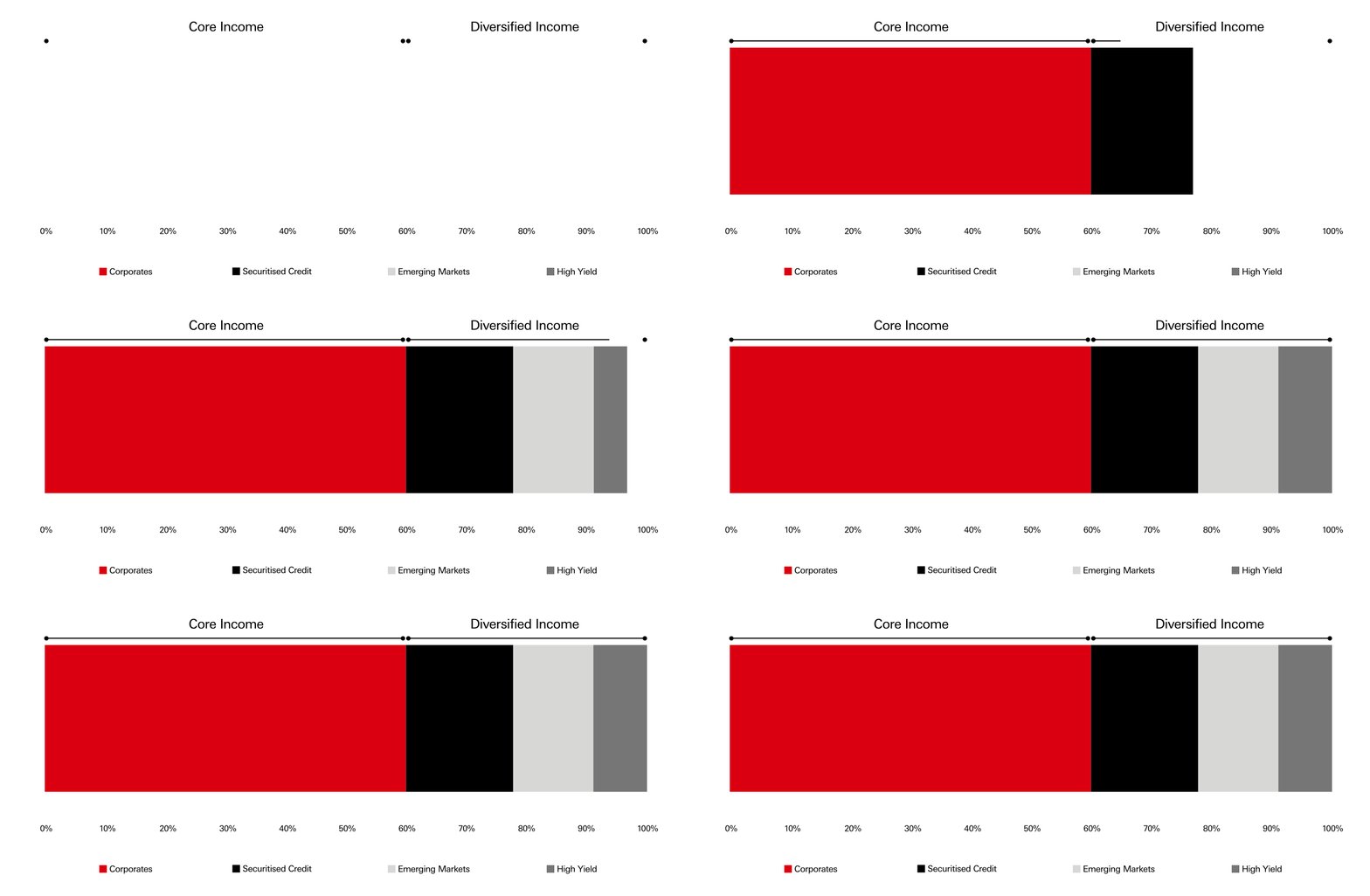
Blending multiple sources of return
Enhancing a core UK corporate bond solution with a blend of global diversified return opportunities, optimising the short-duration fixed income universe.
-
Short Duration Corporates: Diversified, high-quality investment grade, predominantly sterling corporate securities
-
High Yield: Yield enhancement focused on short dated high yield credit
-
Securitised Credit: Low correlations, low duration and income generation
-
Emerging Markets: Diversification and yield enhancement
-
Others: Tactical investment opportunities:
-
Governments: Risk-off protection
-
CoCos: Additional alpha scorce
The sterling short duration optimal income strategy has potential to deliver lower volatility and a higher return than UK fixed income only.
Why HSBC Asset Management for Fixed Income?
A specialised manager focused on delivering consistent, value-added solutions.
 |
 |
 |
|
Extracting value from a broad fixed income universe, not just US or EU |
 |
Benefitting from the strength and resources of HSBC’s Global Fixed Income platform |
|
Enhanced scrutiny for credit intensive segments as outperformance drivers |
|
Extensive top-down and bottom-up, “boots on the ground” proprietary credit research and specialised teams |
|
Dynamic and diversified approach to asset allocation |
|
Reflecting market specialist team expertise |
|
Risk controlled, risk-adjusted returns focus |
|
Upfront quantitative risk calibration for rigorous position sizing and monitoring |
Key documents and Insights

Fund Overview
An at-a-glance summary of the strategy: sterling core, global opportunities, and multiple income drivers within a flexible framework.

Article: Navigating today’s fixed income markets
The case for sterling short-duration multi-sector credit: real income, lower rate sensitivity, global exposure and practical liquidity.

Fund Information
View the latest share class details, NAV currency, ISIN and fund documentation.

A guide for your clients
An introduction to help your retail clients understand the fund, how it invests and the potential role it could play in their investment portfolio.
The Investment Team |
|||||
 |
Mohamed Siddeeq Director, Fixed Income - Global & UK Mohamed Siddeeq is a credit specialist portfolio manager in the Global Bond team within HSBC Asset Management in London and has been working in the financial industry since 1986. Mohamed is responsible for managing global and UK credit bond portfolios. Mohamed holds a BSc in Physics from the University of Bristol (UK) as well as the Investment Management Certificate. |
 |
Paul Mitchell Senior Investment Specialist Paul Mitchell is a senior investment specialist for the Global, Securitised and Sterling Fixed Income capabilities at HSBC Asset Management and brings over 27 years of asset management experience to the role. He holds an honours degree in Economics from Kingston University and the Investment Management Certificate. |
 |
Jai Lakhani Senior Investment Specialist Jai Lakhani is an investment specialist for the Global, Securitised and Sterling Fixed Income capabilities at HSBC Asset Management and brings over 10 years’ experience to the role. He holds an honours degree in Economics from Warwick University and the Investment Management Certificate. Jai is also a CFA charterholder. |
Get in Touch

Matthew Fraser-Sage Director, Business Development, London and South UK matthew.sage@hsbc.com Tel: +44 (0)20 7024 0435 Mobile: +44 (0)7920 021461 |

Pippa Barnwell Director, Business Development pippa.barnwell@hsbc.com Mobile: +44 (0)7384 794 347 |

Simon Page Director, Business Development, North and Scotland simon.page@hsbc.com Mobile: +44 (0)7584 401171 |
Key Risks
The value of investments and any income from them can go down as well as up and investors may not get back the amount they originally invested.
- Callable Bond Risk: Any unexpected behaviour in interest rates could negatively impact the performance of callable debt securities (securities whose issuers have the right to pay off the security’s principal before the maturity date).
- ABS Risk: Asset Backed Securities (ABS) typically carry prepayment risk, which is the risk that such securities may not meet expected repayment schedules. As well as having potential for default, the securities can also carry an above average risk of being hard to value or to sell at a desired time and price.
- CoCo Bond Risk: Contingent convertible securities (CoCo bonds) are comparatively untested, their income payments may be cancelled or suspended, and they are more vulnerable to losses than equities and can be highly volatile.
- Convertible Bond Risk Convertible securities are structured as bonds that typically can, or must, be repaid with a predetermined quantity of equity shares, rather than cash. Therefore, they carry both the risks of equities, and the credit and default risks typical of bonds.
- Counterparty Risk: The possibility that the counterparty to a transaction may be unwilling or unable to meet its obligations.
- Credit Risk: A bond or money market security could lose value if the issuer’s financial health deteriorates.
- Default Risk: The issuers of certain bonds could become unwilling or unable to make payments on their bonds.
- Derivatives Risk: Derivatives can behave unexpectedly. The pricing and volatility of many derivatives may diverge from strictly reflecting the pricing or volatility of their underlying reference(s), instrument or asset.
- Emerging Markets Risk: Emerging markets are less established, and often more volatile, than developed markets and involve higher risks, particularly market, liquidity and currency risks.
- Exchange Rate Risk: Changes in currency exchange rates could reduce or increase investment gains or investment losses, in some cases significantly.
- Interest Rate Risk: When interest rates rise, bond values generally fall. This risk is generally greater the longer the maturity of a bond investment and the higher its credit quality.
- Investment Leverage Risk: Investment Leverage occurs when the economic exposure is greater than the amount invested, such as when derivatives are used. A Fund that employs leverage may experience greater gains and/or losses due to the amplification effect from a movement in the price of the reference source.
- Liquidity Risk: Liquidity Risk is the risk that a Fund may encounter difficulties meeting its obligations in respect of financial liabilities that are settled by delivering cash or other financial assets, thereby compromising existing or remaining investors.
- Operational Risk: Operational risks may subject the Fund to errors affecting transactions, valuation, accounting, and financial reporting, among other things.
For more detailed information on the risks associated with this fund, Investors should refer to the prospectus of the fund.
Important Information
For Professional Clients only and should not be distributed to or relied upon by Retail Clients.
The material contained herein is for marketing purposes and is for your information only. This document is not contractually binding nor are we required to provide this to you by any legislative provision. It does not constitute legal, tax or investment advice or a recommendation to any reader of this material to buy or sell investments. You must not, therefore, rely on the content of this document when making any investment decisions.
This document is not intended for distribution to or use by any person or entity in any jurisdiction or country where such distribution or use would be contrary to law or regulation. This document is not and should not be construed as an offer to sell or the solicitation of an offer to purchase or subscribe to any investment.
The contents are confidential and may not be reproduced or further distributed to any person or entity, whether in whole or in part, for any purpose. This presentation is intended for discussion only and shall not be capable of creating any contractual or other legal obligations on the part of HSBC Global Asset Management (UK) Limited or any other HSBC Group company.
The document is based on information obtained from sources believed to be reliable but which have not been independently verified. HSBC Global Asset Management (UK) Limited and HSBC Group accept no responsibility as to its accuracy or completeness. Care has been taken to ensure the accuracy of this presentation but HSBC Global Asset Management (UK) Limited accepts no responsibility for any errors or omissions contained therein.
This document and any issues or disputes arising out of or in connection with it (whether such disputes are contractual or non-contractual in nature, such as claims in tort, for breach of statute or regulation or otherwise) shall be governed by and construed in accordance with English law.
Any views expressed were held at the time of preparation and are subject to change without notice. While any forecast, projection or target where provided is indicative only and not guaranteed in any way. HSBC Global Asset Management (UK) Limited accepts no liability for any failure to meet such forecast, projection or target.
This Sterling Short Duration Optimal Income Bond Fund is a sub-fund of HSBC Investment Funds, an Open Ended Investment Company that is authorised in the UK by the Financial Conduct Authority. The Authorised Corporate Director is HSBC Asset Management (Fund Services UK) Limited and the Investment Manager is HSBC Global Asset Management (UK) Limited (HSBC Global Asset Management (France) in respect of the Europe Ex UK Equity Fund). All applications are made on the basis of the HSBC Investment Funds prospectus, Key Investor Information Document (KID), Supplementary Information Document (SID) and most recent annual and semi annual report, which can be obtained upon request free of charge from HSBC Global Asset Management (UK) Limited, 8, Canada Square, Canary Wharf, London, E14 5HQ, UK, or the local distributors. Investors and potential investors should read and note the risk warnings in the prospectus and relevant KID and additionally, in the case of retail clients, the information contained in the supporting SID.
The value of investments and any income from them can go down as well as up and investors may not get back the amount originally invested. Where overseas investments are held the rate of currency exchange may also cause the value of such investments to fluctuate. Investments in emerging markets are by their nature higher risk and potentially more volatile than those inherent in some established markets. Stock market investments should be viewed as a medium to long term investment and should be held for at least five years. Any performance information shown refers to the past and should not be seen as an indication of future returns.
The value of the underlying assets is strongly affected by interest rate fluctuations and by changes in the credit ratings of the underlying issuer of the assets. The sub-fund can invest in sub investment grade bonds, which may produce a higher level of income than investment grade bonds, but carry increased risk of default on repayment. The performance of bonds, gilts and other fixed interest securities tends to be less volatile than those of shares of companies (equities). However, there is a risk that both the relative yield and the capital value of these may be reduced if interest rates go up. Income offered by bonds often reflects, in part, the risk rating of the issuer. The underlying funds can invest in sub investment grade bonds, which may produce a higher level of income than investment grade bonds, but carry increased risk of default on repayment. This may affect the level of income the investor receives and/or the capital value of their investment. The level of yields is not guaranteed and may rise or fall in the future.
To help improve our service and in the interests of security we may record and/or monitor your communication with us. HSBC Global Asset Management (UK) Limited provides information to Institutions, Professional Advisers and their clients on the investment products and services of the HSBC Group.
Approved for issue in the UK by HSBC Global Asset Management (UK) Limited, who are authorised and regulated by the Financial Conduct Authority.
HSBC Asset Management is the brand name for the asset management business of HSBC Group, which includes the investment activities provided through our local regulated entity, HSBC Global Asset Management (UK) Limited.
www.assetmanagement.hsbc.co.uk
Copyright © HSBC Global Asset Management (UK) Limited 2026. All rights reserved.