

Private Markets View
Q2
Strategy Snapshot
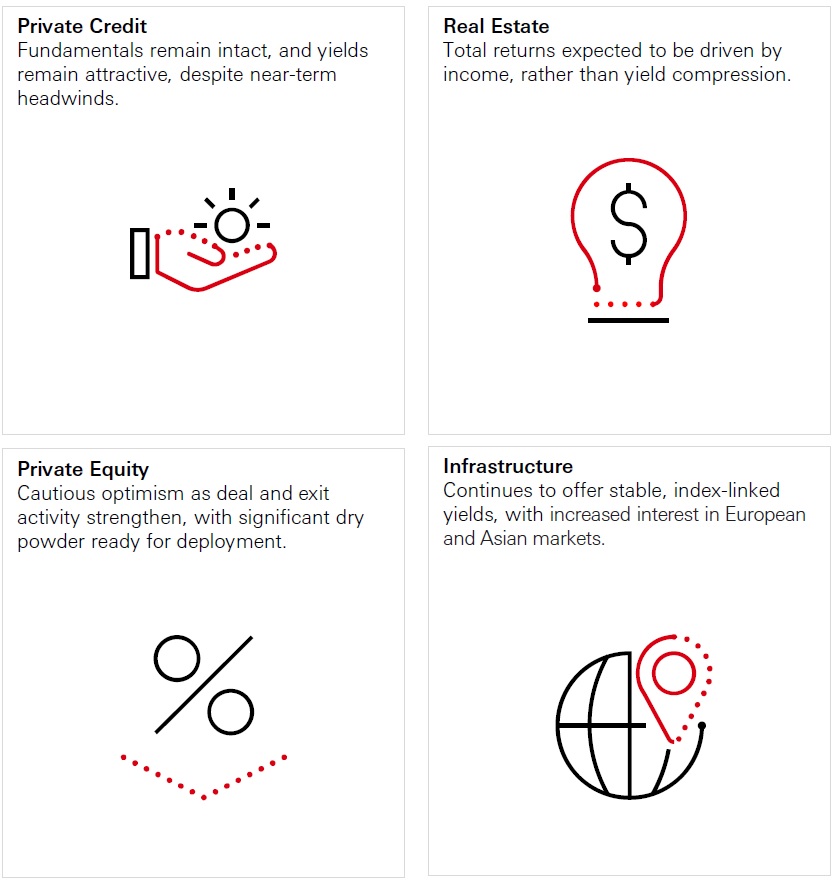
Our key perspectives for each Private Markets Strategy
Click the image to enlarge
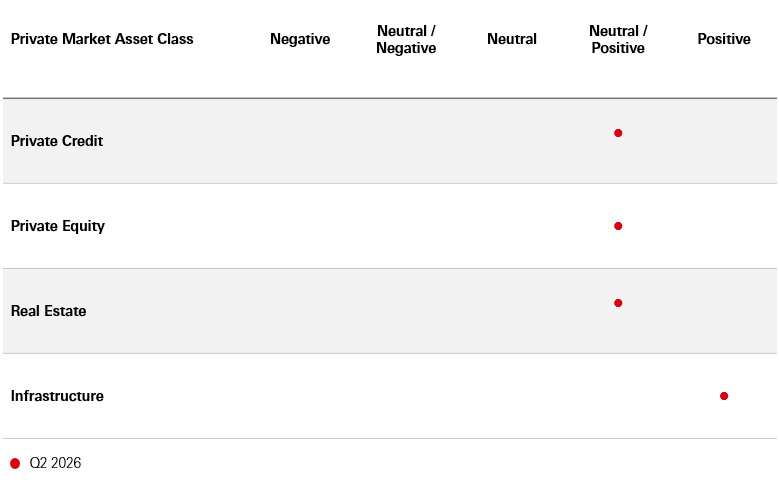
Proposed Strategy Views
We believe the opportunity set for Private Market strategies remains deep.
- We have revised our Private Credit outlook to ‘Neutral / Positive’. Private credit fundamentals remain intact, and yields remain attractive, but ongoing geopolitical headwinds and evolving market sentiment regarding liquidity alignment and redemptions in the space could result in spill-over effects across the broader Private Credit market
- We maintain our stance on Private Equity at ‘Neutral / Positive’. The outlook is cautiously optimistic with exit markets having recovered from earlier challenges, supported by rate cuts, strong corporate earnings, and resurging M&A and IPO activity. However, elevated geopolitical risks and ongoing tariff uncertainties remain key concerns
- In Real Estate, we hold a ‘Neutral / Positive’ outlook for the asset class. As investor sentiment has improved, investment volumes increased in 2025, driven by a strong end to the year. Total returns in Real Estate are expected to be driven by income, rather than yield compression as high-quality office and retail sectors are expected to perform particularly well
- Infrastructure investment trends continue to be shaped by the Trump administration's policies, with increased interest in European and Asian markets due to stable environments and diversification benefits. We maintain a ‘Positive’ view on the asset class
Click the image to enlarge
Our Asset Class Views
Private Credit
Neutral / Positive
Review of Q4
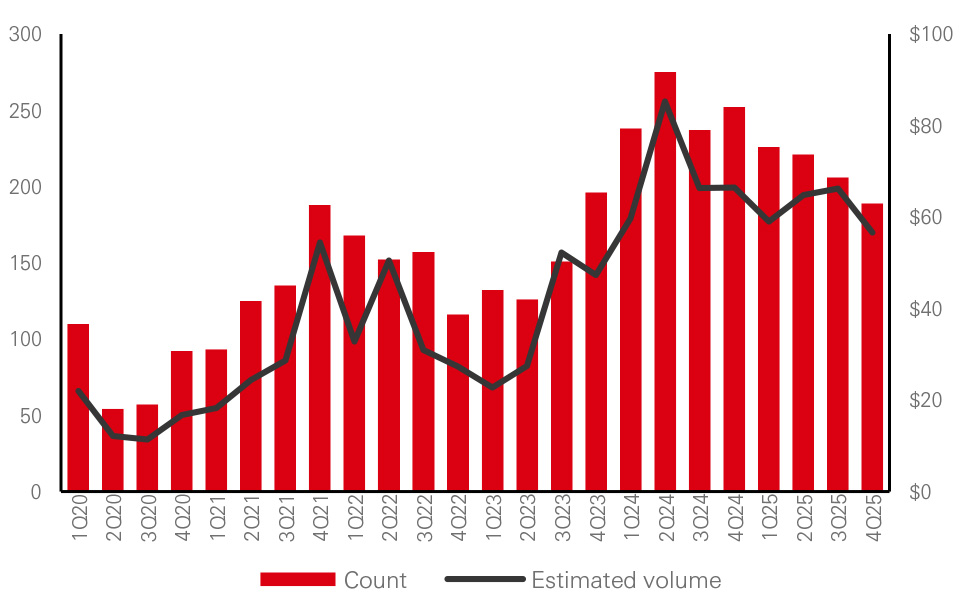
Private credit–financed deal activity in the US market slowed in Q4, with deal count down 25.0 per cent and volume down roughly 14.8 per cent year-over-year. With fewer deals supporting buyouts and M&A, the imbalance between demand for private credit and available supply continues to deepen.
In contrast, stress and default risk, which dominated Q2 concerns, have since taken a backseat. However, 2025 overall was the second-busiest year for direct lenders in at least 8 years, although down from record 2024. US deal volume in 2025 was 11 per cent down and deal activity was 16 per cent down from 2024.
In the US, average direct lending spreads held steady at 475bps. In a competitive tug-of-war for deal flow, direct lenders in the US captured roughly USD37 billion from the BSL market this year, offset by a slightly smaller flow in the other direction.
US direct lending activity was down in Q4 2025 but 2025 was a strong year overall
Direct Lending deal count and estimated volume (US, USD billion)
Click the image to enlarge
Source: HSBC Alternatives, LCD Pitchbook as of Dec 2025
In Europe, direct lending broke records in 2025. Year-end data shows that the total estimated volume and deal flow in this market — at EUR41.4 billion and 160 transactions — surpassed 2024 levels. Refinancings and recaps drove activity levels – Such deals accounted for a significant EUR18.3 billion in 2025, up from EUR14.2 billion in 2024.
Spreads in Europe continue to tighten. More than a third of buyouts were priced below 500 bps in 2025, compared to none in 2023-2024, while average spreads across all direct lending transactions are now 100 bps tighter than in 2022.
European lenders are steering towards the lower mid-market space, with buyouts also showing a trend toward smaller transactions. Direct lenders funded more than four times as many buyouts than in the broadly syndicated market in the fourth quarter of 2025.
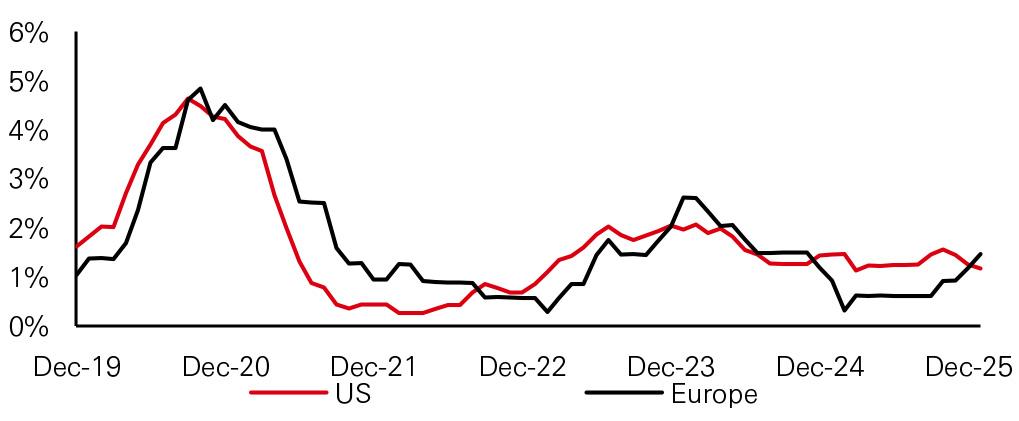
Default rates remain resilient
Leveraged Loans Index Default Rates
Click the image to enlarge
Source: HSBC Alternatives, LCD Pitchbook as of Dec 2025
12-month outlook
In Q4 2025, the US BDC market experienced elevated levels of redemptions from retail investors. We expect this to continue in Q1 2026, mainly driven by retail investor reaction to negative headlines regarding private credit and concerns around software exposure in these vehicles, which has contributed to valuation pressures.
Regulatory oversight of private credit may intensify in light of recent activity within the BDC market. The focus of these developments has been on liquidity alignment and market expectations, rather than credit quality deterioration.
Direct lending continues to show stability and yield premium over public markets combined with regular income derived from underlying interest payments. Loan origination remains an area of focus, resulting in continued spread compression and slower pace of deployment.
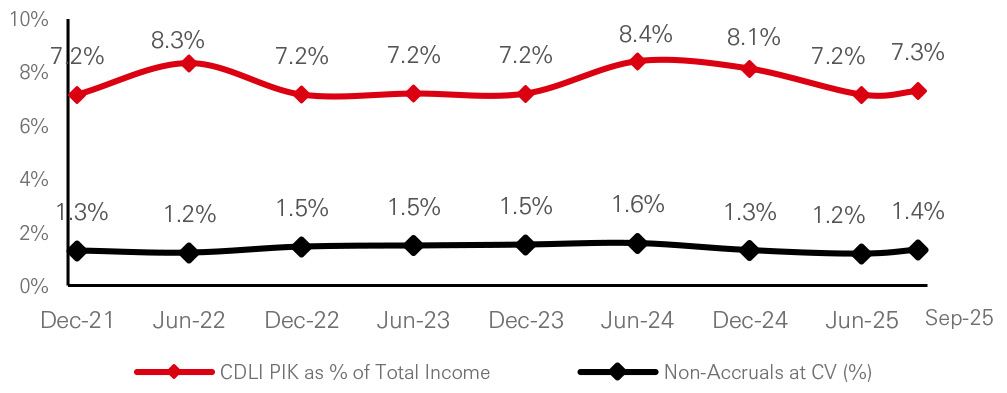
Although default rates and non-accruals continue to remain low by historical standards, modest credit deterioration may persist, but proactive equity sponsor support combined with lender flexibility should contain a broader fallout. During periods of stress, sponsors are expected to rely heavily on tools allowing for flexibility— including PIK toggles and extended maturities — to navigate rate volatility and borrower-level headwinds.
PIK income increased modestly in Q3 2025 but remains in line with the five-year average
Cliffwater CDLI – PIK as a per cent of Total Income & Non-Accruals
Click the image to enlarge
Source: HSBC Alternatives, Cliffwater as of Sept 2025
Private Equity
Neutral / Positive
Review of Q4
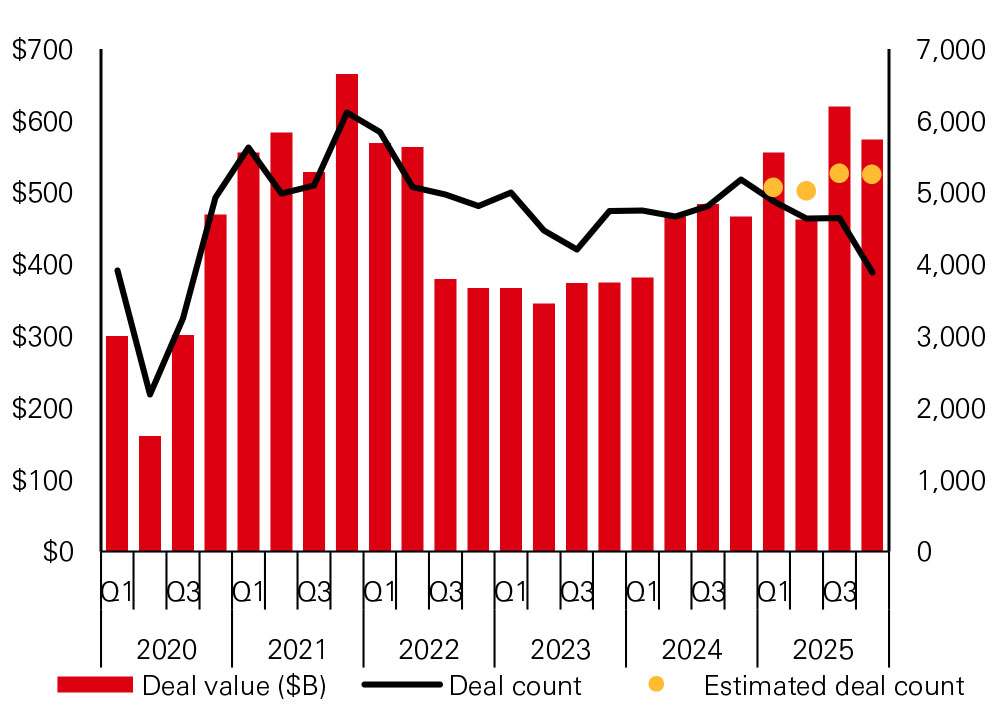
Dealmaking recovered rapidly in the second half of 2025 on easing concerns of tariff escalation, falling interest rates and narrowing bid-ask spreads. Q4 2025 show deal value of USD573.3 billion, following a stellar Q3 where deal value reached USD619.9 billion. Overall, in 2025, Global PE dealmaking totalled USD2.21tn, the highest level since 2021, and 23 per cent higher than 2024. Deal count in 2025 was 6 per cent higher than 2024 levels (based on estimated deal count).
US PE deal activity by quarter
Capital Invested (LHS), Deal Count (RHS)
Click the image to enlarge
Source: HSBC Alternatives, Pitchbook as of Dec 2025
Activity in high-growth sectors – including AI/technology, healthcare, defence, and the energy transition – has driven much of the headline figures.
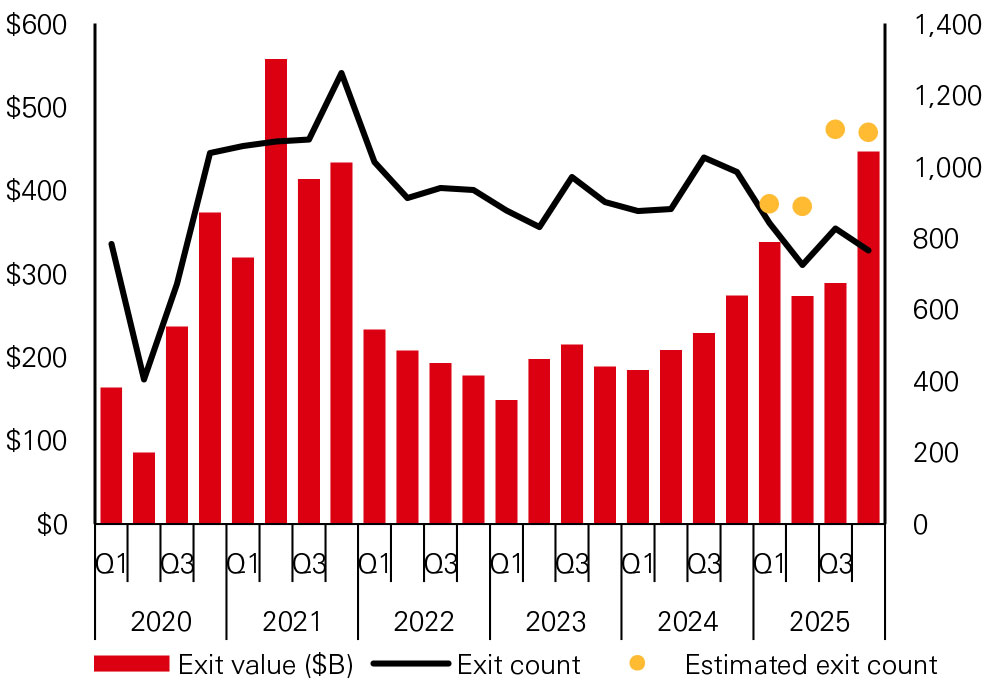
US PE exit activity by quarter
Exit Value (LHS), Exit Count (RHS)
Click the image to enlarge
Source: HSBC Alternatives, Pitchbook as of Dec 2025
2025 has been the strongest year for exits since 2021. Exit value over the year was USD1.35tn, 50 per cent higher than in 2024. Exit count rose over 5 per cent in 2025 compared to 2024. Q4 2025 saw total exit value rising to USD446.7 billion, the highest level since Q2 2021, with technology and healthcare sectors leading the way. Among the key drivers of strong exit activity in H2 2025 has been a resurgence in M&A. There was a strong rebound in M&A, which reached a record high of nearly USD5 trillion in deal value in 2025, driven by several billion-dollar-plus transactions. IPOs are also recovering.
Secondaries remain an attractive exit route. Secondaries value was 57 per cent of total exit value (up sharply from previous quarters) and secondaries volume (count) represented 21 per cent of total exit volume. Importantly, net asset values are increasing across private equity portfolios, reflecting healthy portfolio company performance.
12-Month Outlook
Encouraging Q4 2025 data suggests a cautiously optimistic outlook for 2026. Easing rate pressure, narrowing bid-ask spreads, and improved buyer confidence have supported a recovery in M&A, trade sales, and IPO activity. As exits increase, the system is beginning to absorb liquidity needs, however rising geopolitical risks are on the horizon.
Tailwinds
- Rate Relief – With the Fed expected to cut rates further this year, financing conditions for buyouts and refinancings should ease further
- Exit Rebound – Elevated equity markets are reopening IPO and trade sale channels, particularly in technology and healthcare portfolios
- Corporate Earnings – Technology and industrial sectors reporting solid earnings, pointing towards overall market resilience
Headwinds
- Elevated geopolitical risks – The conflict between US-Israel and Iran could be a headwind for global growth. Higher oil prices could increase inflationary pressures and costs for consumer and businesses
- AI disruption risks – In recent weeks, we have seen concerns that advancements in AI could threaten the business models of certain SaaS companies. Disruption could also create new winners and challengers in the software and tech space
Real Estate
Neutral / Positive
Review of Q4
Investors increasingly consider real estate as offering fair value, reflected by the stabilisation in capital values in 2025 and a growing appreciation of its defensive qualities. As investor sentiment has improved, investment volumes increased in 2025, driven by a strong end to the year. Still, volumes remained below the five-year average.
In the office sector, a sharp reduction in new development has supported a stabilisation in vacancy rates. Prime CBD space in gateway cities is increasingly scarce – London new-build vacancy is just 1.3 per cent (JLL), Tokyo Grade A is 1.4 per cent (CBRE) and year-to-date Manhattan leasing was well above the long-term average – driving healthy prime rental growth. Wider US office vacancy rates rose to c20 per cent (C&W), underscoring the bifurcation between prime and secondary.
Retail vacancy rates are near record lows following a decade of minimal new supply across the US, Europe and much of Asia, including Hong Kong, where Grade A retail rents rose for the first time since 2019. Consumer resilience has driven robust retailer leasing activity, rising occupancy, and widespread rental growth, particularly for grocery-anchored retail parks and regional malls in affluent neighbourhoods.
Conditions in the logistics sector have been soft after a stellar performance during the pandemic, as new supply continued to enter the market, though indications suggest the market is stabilising. The US logistics vacancy rate was flat at 7.1 per cent (C&W) in Q4 2025, while European vacancy rates appear to have peaked and are slowly declining in the UK, Eastern Europe and Spain. In Asia-Pacific market fundamentals are mixed, though regional rental growth is trending lower.
The residential sector has the lowest vacancy rates, supported by ongoing urbanisation trends, a lack of new supply and widespread affordability constraints for buying.
Global data centre fundamentals remained exceptionally strong throughout 2025, with vacancy rates near historic lows and pre-commitments on new supply approaching 80 per cent (JLL), reflecting strong demand from AI and hyperscalers. Availability of power is a key factor constraining new supply.
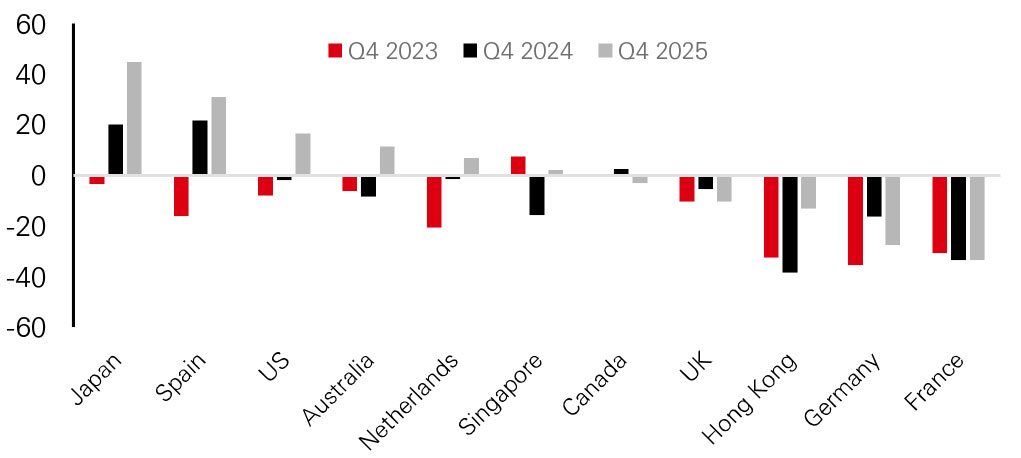
Occupier Sentiment Index*
Click the image to enlarge
Source: HSBC Alternatives, as of Dec 2025. * The OSI is constructed by taking an unweighted average of three key series, measured on a net balance basis: Leasing demand, Level of incentives offered to tenants, 3-month rental expectations.
12-Month Outlook
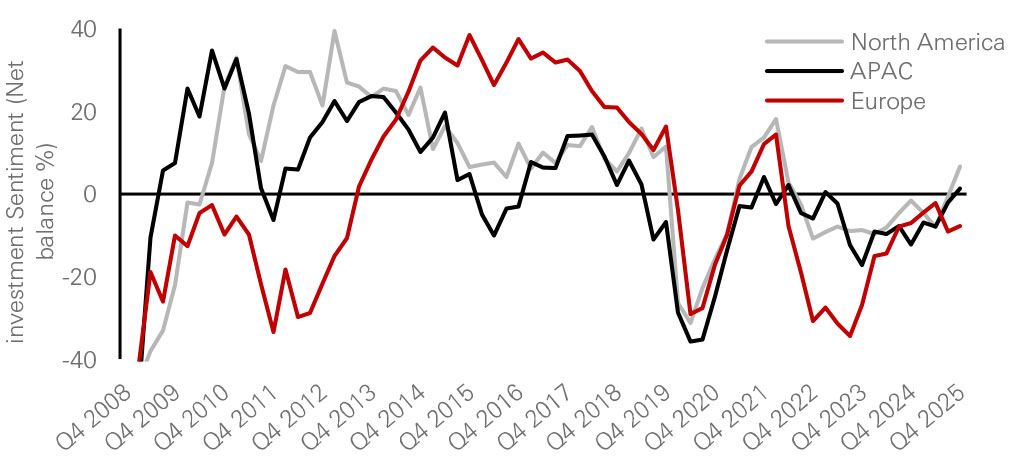
With limited scope for yield compression while interest rates remain elevated, total returns are expected to be driven by income rather than capital growth. The widespread improvement in occupier sentiment in 2025 points to a stronger leasing backdrop in 2026, supporting income growth across sectors.
Whilst the impact of AI on white collar work is unknown, the weight of opinion is that it will reduce overall demand for office space but concentrate occupiers on higher-quality space. A modest development pipeline, combined with the repurposing of obsolete stock for other uses, should sustain upward rental pressure for the best-quality space.
Retail is well positioned to outperform. Property yields offer an attractive spread over other property types, development pipelines are minimal, and leasing demand is resilient. Grocery-anchored neighbourhood retail is the favoured sub-sector, given high occupancy and depth of demand.
We remain cautious on logistics in the near-term. Yields are compressed and income growth, while still positive, is expected to be modest in 2026. That said, the year should mark a transition point as new supply moderates, demand is supported by e-commerce growth and supply chain resilience strategies and increased European defence spending may provide additional leasing impetus.
Residential should remain resilient, underpinned by stable demand and low vacancy rates. US coastal multifamily should outperform the Sunbelt, though the gap is expected to narrow. Senior housing offers the most compelling growth outlook as the population ages. In Asian, Japan and Singapore offer strong multifamily fundamentals.
The ongoing conflict in the Middle East is a key downside risk. Elevated oil prices have pushed government bond yields higher, potentially pushing up property yield, while a protracted conflict would weigh on occupier sentiment – particularly in cyclically sensitive sectors such as offices and retail. More defensive sectors would include high occupancy residential, and sectors with structural demand tailwinds: senior housing, data centres, and logistics.
Investment Sentiment Index*
Click the image to enlarge
Source: HSBC Alternatives, as of Dec 2025. * The Investment Sentiment Index (ISI) is constructed by taking an unweighted average of net balance readings from three key investment-focused questions: Investment Enquiries, 12-month Capital Value Expectations, Supply of commercial property currently for sale.
Infrastructure
Positive
Review of Q4
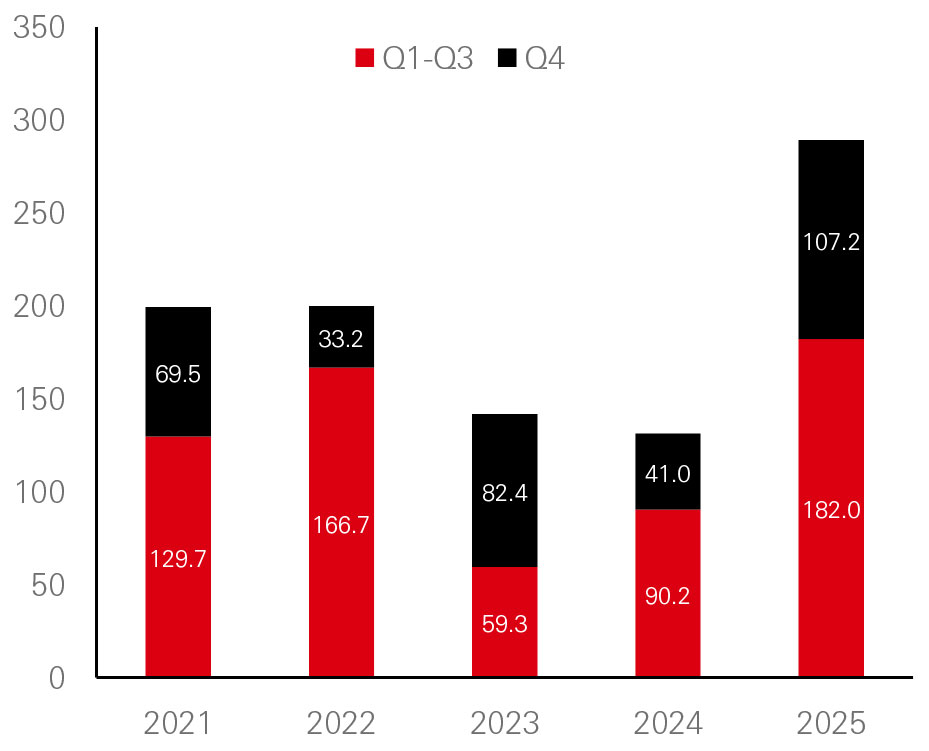
Q4 2025 marked a record year for private infrastructure capital fundraising, with USD289.2 billion raised far exceeding the total for 2024. We consider that it is illustrative of the attractiveness of infrastructure as a stable asset class in an overall investment universe that faces significant challenges.
Infrastructure fundraising sees significant uptick
Private Infrastructure Capital Raised (USD billion) in the past 5 years
Click the image to enlarge
Source: HSBC Alternatives, Institutional Investor, data as of Dec 2025
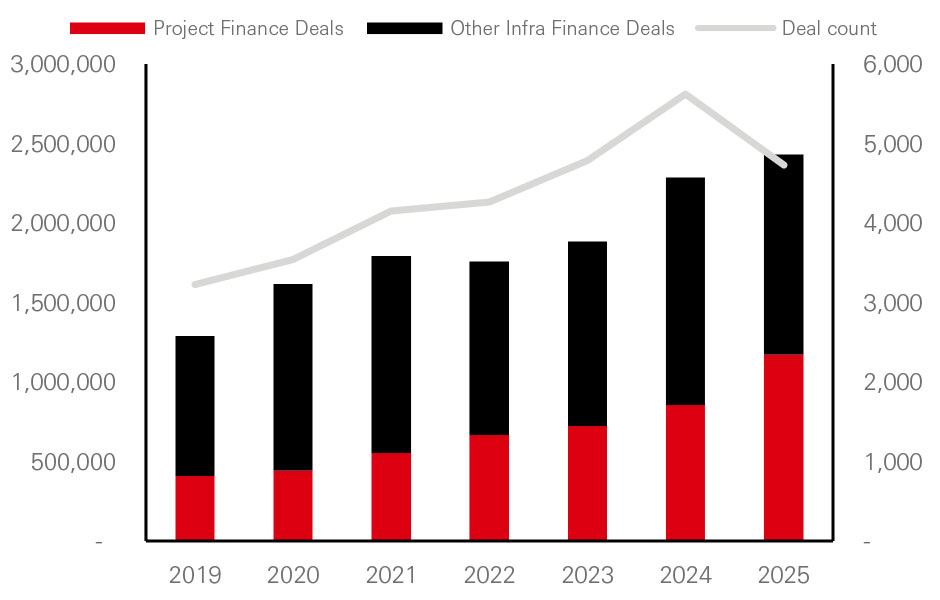
Importantly, financing markets have reopened, and deal volumes are increasing after the rate shock of 2022–23. Diverse funding sources support resilience across market cycles. Activity has been strong across value-add and core/core+ transactions. With more capital chasing assets, underwriting discipline and sourcing advantage are critical.
Global infrastructure finance value (USDm) and volume, 2019-2025
Click the image to enlarge
Source: HSBC Alternatives, data as of Dec 2025
12-Month Outlook
The outlook for infrastructure remains dominated by the Trump administration. We see signs that this may lead to greater investor interest in European and Asian infrastructure. The former can be seen as having a more stable policy environment and the latter offers geographical diversification and, in general, the potential for enhanced returns. We continue to monitor US policies on aspects of infrastructure investing:
- The Big Beautiful Bill Act significantly curtails the tax benefits available to solar and wind energy investments. This is likely to lead to a short-term surge in renewable energy investment activity in the United States followed by a lull when the deadline for eligibility for tax credits expires. Ultimately, however, this sector will resume its growth because onshore wind and solar are price competitive without tax breaks and can be developed more quickly than gas fired power plants. In the energy sector, we favour diversifying investment across North America, western Europe and developed Asia.
- Inflation: Any increase in tariffs and the prospect of a growing US fiscal deficit may lead to the Federal Reserve keeping interest rates higher for longer. Infrastructure assets tend to be positively correlated with inflation (because their income streams are often index linked) and robust to the interest rate cycle (because they often have long term, fixed rate financing).
Digital infrastructure was the single largest global infrastructure sector in 2025, largely due to data centre investing. We see many data centre investment opportunities with very attractive potential returns. A lot of these are, however, heavily dependent on the maintenance of current high earnings multiple valuations five to eight years from now. This dependence is unlike a classic infrastructure risk profile in which a large proportion of returns are generated from high operating margins, delivering significant distributions. We prefer mature portfolios of operating data centres with limited exposure to the development of new capacity, which offer more moderate returns in exchange for lower risk.
The conflict in the Middle East could introduce short-term volatility for private infrastructure through higher energy prices, supply chain disruption, and elevated geopolitical risk. However, it may also reinforce long-term investment in domestic energy security and power grids. If the conflict is protracted, this should reinforce the benefits of infrastructure’s contracted revenues and inflation-linked cashflows, which are not linked to the economic cycle, and that provide resilience when risks are elevated.
The views expressed above were held at the time of preparation and are subject to change without notice. Any forecast, projection or target where provided is indicative only and is not guaranteed in any way. HSBC Asset Management accepts no liability for any failure to meet such forecast, projection or target. Past performance does not predict future returns.Diversification does not ensure a profit or protect against a loss. This information shouldn't be considered as a recommendation to invest in the specific sector mentioned.
Source: HSBC Asset Management, as of March 2026.
Important Information
Risks of investing in Private Markets
The value of investments and income from them can go down as well as up, meaning you may not get back the amount invested, and you may lose some or all of your investment. Past performance information presented is not indicative of future performance. The return and costs may increase or decrease as a result of currency fluctuations.
- Alternative Risk - There are additional risks associated with specific alternative investments within the portfolios; these investments may be less readily realisable than others and it may therefore be difficult to sell in a timely manner at a reasonable price or to obtain reliable information about their value; there may also be greater potential for significant price movements
- Liquidity Risk - Investors may be unable to dispose of an investment quickly or at all and at a price that’s closely related to recent similar transactions, if any. There is no guarantee of distributions and secondary market is expected to be established
- Event Risk - A significant event may cause a substantial decline in the market value of all securities
- Long-term Horizon - Investors should expect to be locked-in for the full term of the investment, which is subject to extensions
- No Capital Protection - Investors may lose the entirety of invested capital
- Unpredictable Cashflows - Capital may be called and distributed at short notice
- Economic Conditions - Ability to realize/divest from existing investments depends on market conditions and the regulatory environment
- Risk of Forfeiture - Failure to make call payments could result in forfeiture of commitment, including invested capital, without compensation
- Default Risk - In the event of default investors risk losing their entire remaining interest in the vehicle and may be subject to legal proceedings to recover unfunded commitments
- Reliance on Third-party Management Teams - Underlying investments will be managed by various third-party management teams that will in aggregate determine the eventual returns for the investor, if any
The risk factors listed above are not exhaustive. Please refer to the relevant product documentation for the full and detailed risk disclosures
Disclaimer
Important Information
For Professional Clients and intermediaries within countries and territories set out below; and for Institutional Investors and Financial Advisors in the US. This document should not be distributed to or relied upon by Retail clients/investors.
The value of investments and the income from them can go down as well as up and investors may not get back the amount originally invested. The performance figures contained in this document relate to past performance, which should not be seen as an indication of future returns. Future returns will depend, inter alia, on market conditions, investment manager’s skill, risk level and fees. Where overseas investments are held the rate of currency exchange may cause the value of such investments to go down as well as up. Investments in emerging markets are by their nature higher risk and potentially more volatile than those inherent in some established markets. Economies in emerging markets generally are heavily dependent upon international trade and, accordingly, have been and may continue to be affected adversely by trade barriers, exchange controls, managed adjustments in relative currency values and other protectionist measures imposed or negotiated by the countries and territories with which they trade. These economies also have been and may continue to be affected adversely by economic conditions in the countries and territories in which they trade.
The contents of this document may not be reproduced or further distributed to any person or entity, whether in whole or in part, for any purpose. All non-authorised reproduction or use of this document will be the responsibility of the user and may lead to legal proceedings. The material contained in this document is for general information purposes only and does not constitute advice or a recommendation to buy or sell investments. Some of the statements contained in this document may be considered forward looking statements which provide current expectations or forecasts of future events. Such forward looking statements are not guarantees of future performance or events and involve risks and uncertainties. Actual results may differ materially from those described in such forward-looking statements as a result of various factors. We do not undertake any obligation to update the forward-looking statements contained herein, or to update the reasons why actual results could differ from those projected in the forward-looking statements. This document has no contractual value and is not by any means intended as a solicitation, nor a recommendation for the purchase or sale of any financial instrument in any jurisdiction in which such an offer is not lawful. The views and opinions expressed herein are those of HSBC Asset Management at the time of preparation and are subject to change at any time. These views may not necessarily indicate current portfolios' composition. Individual portfolios managed by HSBC Asset Management primarily reflect individual clients' objectives, risk preferences, time horizon, and market liquidity. Foreign and emerging markets: investments in foreign markets involve risks such as currency rate fluctuations, potential differences in accounting and taxation policies, as well as possible political, economic, and market risks. These risks are heightened for investments in emerging markets which are also subject to greater illiquidity and volatility than developed foreign markets. This commentary is for information purposes only. It is a marketing communication and does not constitute investment advice or a recommendation to any reader of this content to buy or sell investments nor should it be regarded as investment research. It has not been prepared in accordance with legal requirements designed to promote the independence of investment research and is not subject to any prohibition on dealing ahead of its dissemination. This document is not contractually binding nor are we required to provide this to you by any legislative provision.
This document provides a high level overview of the recent economic environment. It is for marketing purposes and does not constitute investment research, investment advice nor a recommendation to any reader of this content to buy or sell investments. It has not been prepared in accordance with legal requirements designed to promote the independence of investment research and is not subject to any prohibition on dealing ahead of its dissemination.
All data from HSBC Asset Management unless otherwise specified. Any third-party information has been obtained from sources we believe to be reliable, but which we have not independently verified.
HSBC Asset Management is the brand name for the asset management business of HSBC Group, which includes the investment activities that may be provided through our local regulated entities. HSBC Asset Management is a group of companies in many countries and territories throughout the world that are engaged in investment advisory and fund management activities, which are ultimately owned by HSBC Holdings Plc. (HSBC Group).
- In Australia, this document is issued by HSBC Bank Australia Limited ABN 48 006 434 162, AFSL 232595, for HSBC Global Asset Management (Hong Kong) Limited ARBN 132 834 149 and HSBC Global Asset Management (UK) Limited ARBN 633 929 718. This document is for institutional investors only and is not available for distribution to retail clients (as defined under the Corporations Act). HSBC Global Asset Management (Hong Kong) Limited and HSBC Global Asset Management (UK) Limited are exempt from the requirement to hold an Australian financial services license under the Corporations Act in respect of the financial services they provide. HSBC Global Asset Management (Hong Kong) Limited is regulated by the Securities and Futures Commission of Hong Kong under the Hong Kong laws, which differ from Australian laws. HSBC Global Asset Management (UK) Limited is regulated by the Financial Conduct Authority of the United Kingdom and, for the avoidance of doubt, includes the Financial Services Authority of the United Kingdom as it was previously known before 1 April 2013, under the laws of the United Kingdom, which differ from Australian laws;
- In Bermuda, this document is issued by HSBC Global Asset Management (Bermuda) Limited, of 37 Front Street, Hamilton, Bermuda which is licensed to conduct investment business by the Bermuda Monetary Authority;
- In France, Belgium, Netherlands, Luxembourg, Portugal, Greece, Finland, Norway, Denmark and Sweden this document is issued by HSBC Global Asset Management (France), a Portfolio Management Company authorised by the French regulatory authority AMF (no. GP99026);
- In Germany, this document is issued by HSBC Global Asset Management (Deutschland) GmbH which is regulated by BaFin (German clients) respective by the Austrian Financial Market Supervision FMA (Austrian clients);
- In Hong Kong, this document is issued by HSBC Global Asset Management (Hong Kong) Limited, which is regulated by the Securities and Futures Commission. This content has not been reviewed by the Securities and Futures Commission;
- In India, this document is issued by HSBC Asset Management (India) Pvt Ltd. which is regulated by the Securities and Exchange Board of India;
- In Italy and Spain, this document is issued by HSBC Global Asset Management (France), a Portfolio Management Company authorised by the French regulatory authority AMF (no. GP99026) and through the Italian and Spanish branches of HSBC Global Asset Management (France), regulated respectively by Banca d’Italia and Commissione Nazionale per le Società e la Borsa (Consob) in Italy, and the Comisión Nacional del Mercado de Valores (CNMV) in Spain;
- In Malta, this document is issued by HSBC Global Asset Management (Malta) Limited which is regulated and licensed to conduct Investment Services by the Malta Financial Services Authority under the Investment Services Act;
- In Mexico, this document is issued by HSBC Global Asset Management (Mexico), SA de CV, Sociedad Operadora de Fondos de Inversión, Grupo Financiero HSBC which is regulated by Comisión Nacional Bancaria y de Valores;
- In the United Arab Emirates, this document is issued by HSBC Investment Funds (Luxembourg) S.A. – Dubai Branch (Level 20, HSBC Tower, PO Box 66, Downtown Dubai, United Arab Emirates) regulated by the Capital Market Authority (CMA) in the UAE to conduct investment fund management, portfolios management, fund administration activities (CMA Category 2 license No.20200000336) and promotion activities (CMA Category 5 license No.20200000327)
- In the United Arab Emirates, this document is issued by HSBC Global Asset Management MENA, a unit within HSBC Bank Middle East Limited, U.A.E Branch, PO Box 66 Dubai, UAE, regulated by the Central Bank of the U.A.E. and the Capital Market Authority in the UAE under CMA license number 602004 for the purpose of this promotion and lead regulated by the Dubai Financial Services Authority. HSBC Bank Middle East Limited is a member of the HSBC Group and HSBC Global Asset Management MENA are marketing the relevant product only in a sub-distributing capacity on a principal-to-principal basis. HSBC Global Asset Management MENA may not be licensed under the laws of the recipient’s country of residence and therefore may not be subject to supervision of the local regulator in the recipient’s country of residence. One of more of the products and services of the manufacturer may not have been approved by or registered with the local regulator and the assets may be booked outside of the recipient’s country of residence
- In Singapore, this document is issued by HSBC Global Asset Management (Singapore) Limited, which is regulated by the Monetary Authority of Singapore. The content in the document/video has not been reviewed by the Monetary Authority of Singapore;
- In Switzerland, this document is issued by HSBC Global Asset Management (Switzerland) AG. This document is intended for professional investor use only. For opting in and opting out according to FinSA, please refer to our website; if you wish to change your client categorization, please inform us. HSBC Global Asset Management (Switzerland) AG having its registered office at Gartenstrasse 26, PO Box, CH-8002 Zurich has a licence as an asset manager of collective investment schemes and as a representative of foreign collective investment schemes. Disputes regarding legal claims between the Client and HSBC Global Asset Management (Switzerland) AG can be settled by an ombudsman in mediation proceedings. HSBC Global Asset Management (Switzerland) AG is affiliated to the ombudsman FINOS having its registered address at Talstrasse 20, 8001 Zurich. There are general risks associated with financial instruments, please refer to the Swiss Banking Association (“SBA”) Brochure “Risks Involved in Trading in Financial Instruments”;
- In Taiwan, this document is issued by HSBC Global Asset Management (Taiwan) Limited which is regulated by the Financial Supervisory Commission R.O.C. (Taiwan);
- In Turkiye, this document is issued by HSBC Asset Management A.S. Turkiye (AMTU) which is regulated by Capital Markets Board of Turkiye. Any information here is not intended to distribute in any jurisdiction where AMTU does not have a right to. Any views here should not be perceived as investment advice, product/service offer and/or promise of income. Information given here might not be suitable for all investors and investors should be giving their own independent decisions. The investment information, comments and advice given herein are not part of investment advice activity. Investment advice services are provided by authorized institutions to persons and entities privately by considering their risk and return preferences, whereas the comments and advice included herein are of a general nature. Therefore, they may not fit your financial situation and risk and return preferences. For this reason, making an investment decision only by relying on the information given herein may not give rise to results that fit your expectations
- In the UK, this document is issued by HSBC Global Asset Management (UK) Limited, which is authorised and regulated by the Financial Conduct Authority;
- In the US, this document is issued by HSBC Securities (USA) Inc., an HSBC broker dealer registered in the US with the Securities and Exchange Commission under the Securities Exchange Act of 1934. HSBC Securities (USA) Inc. is also a member of NYSE/FINRA/SIPC. HSBC Securities (USA) Inc. is not authorized by or registered with any other non-US regulatory authority. The contents of this document are confidential and may not be reproduced or further distributed to any person or entity, whether in whole or in part, for any purpose without prior written permission
- In Chile, operations by HSBC's headquarters or other offices of this bank located abroad are not subject to Chilean inspections or regulations and are not covered by warranty of the Chilean state. Obtain information about the state guarantee to deposits at your bank or on www.cmfchile.cl;
- In Colombia, HSBC Bank USA NA has an authorized representative by the Superintendencia Financiera de Colombia (SFC) whereby its activities conform to the General Legal Financial System. SFC has not reviewed the information provided to the investor. This document is for the exclusive use of institutional investors in Colombia and is not for public distribution;
- In Costa Rica, the Fund and any other products or services referenced in this document are not registered with the Superintendencia General de Valores (“SUGEVAL”) and no regulator or government authority has reviewed this document, or the merits of the products and services referenced herein. This document is directed at and intended for institutional investors only
- In Peru, HSBC Bank USA NA has an authorized representative by the Superintendencia de Banca y Seguros in Perú whereby its activities conform to the General Legal Financial System - Law No. 26702. Funds have not been registered before the Superintendencia del Mercado de Valores (SMV) and are being placed by means of a private offer. SMV has not reviewed the information provided to the investor. This document is for the exclusive use of institutional investors in Perú and is not for public distribution;
- In Uruguay, operations by HSBC's headquarters or other offices of this bank located abroad are not subject to Uruguayan inspections or regulations and are not covered by warranty of the Uruguayan state. Further information may be obtained about the state guarantee to deposits at your bank or on www.bcu.gub.uy
NOT FDIC INSURED ♦ NO BANK GUARANTEE ♦ MAY LOSE VALUE
Copyright © HSBC Global Asset Management Limited 2026. All rights reserved. No part of this publication may be reproduced, stored in a retrieval system, or transmitted, on any form or by any means, electronic, mechanical, photocopying, recording, or otherwise, without the prior written permission of HSBC Asset Management.
Content ID: D066748_v1.0; Expiry Date: 01.03.2027