

HSBC Asset Management
Opening up a world of opportunity
HSBC Asset Management have been managing multi-asset investment solutions for over 30 years and we have extensive experience working with financial advisers in the UK.
Why invest with HSBC Asset management?
- HSBC Asset Management is a truly global asset manager
- Over 600 investment professionals worldwide
- Our local presence provides greater insight into the markets and companies in which we invest
- USD146 billion AUM in multi-asset strategies1
- ESG is a critical component of HSBC’s multi-asset investment process
Scroll down to learn about our multi-asset solutions for advisers and to download the relevant fund materials.
HSBC Global Strategy Portfolios
Our flagship multi-asset solution for advisory clients.
- Five funds, tailored to different investor risk attitudes and diversified across key asset classes and global regions, including developed and emerging markets
- Cost effective, with asset allocation primarily driven via passive strategies
- OCFs range from 17 to 21 bps2
- Accessible via all major UK platforms
|
|
HSBC Global Strategy Portfolios
|
HSBC Global Sustainable Multi Asset Portfolios
Five risk targeted portfolios with exposure to all major asset classes and managed with active strategic and tactical asset allocation.
- Focus on sustainable investment
- Uses the same investment philosophy as the Global Strategy Portfolios
- Five portfolios offering different risk levels
- OCFs range from 61 to 73 bps2
|
|
HSBC Global Sustainable Multi |
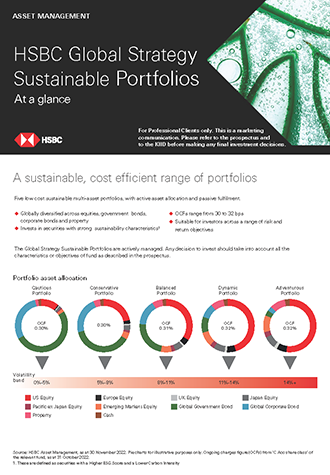
HSBC Global Strategy Sustainable Portfolios
Five low-cost sustainable multi-asset portfolios, with active asset allocation and passive fulfilment.
- Globally diversified across equities, government bonds, corporate bonds and property
- Invests in securities with strong sustainability characteristics2
- OCFs range from 30 to 32 bps2
- Suitable for investors across a range of risk and return objectives
|
|
HSBC Global Strategy |
HSBC Global Managed Portfolio Service
A cost-efficient, globally diversified managed portfolio service from a highly experienced team.
- Five globally diversified, risk-rated portfolios
- World leading asset manager and trusted brand
- Access to investment specialists and comprehensive insights and materials
- One of the lowest cost, actively managed MPS services on the market
- OCFs between 22 to 24 bps.2
|
|
HSBC Global Managed Portfolio |
1 Source: HSBC Asset management as at 30 September 2022
2 Source: HSBC Asset management as at 30 December 2022
Key risks
Investing involves risk and the value of an investment and the income from it may fall as well as rise. You may not get back the full amount invested.
Counterparty Risk: The possibility that the counterparty to a transaction may be unwilling or unable to meet its obligations.
Credit Risk: A bond or money market security could lose value if the issuer’s financial health deteriorates.
Default Risk: The issuers of certain bonds could become unwilling or unable to make payments on their bonds.
Derivatives Risk: Derivatives can behave unexpectedly. The pricing and volatility of many derivatives may diverge from strictly reflecting the pricing or volatility of their underlying reference(s), instrument or asset.
Emerging markets risk: Emerging economies typically exhibit higher levels of investment risk. Markets are not always well regulated or efficient and investments can be affected by reduced liquidity.
Exchange rate risk: Investing in assets denominated in a currency other than that of your own currency perspective exposes the value of the investment to exchange rate fluctuations.
Interest Rate risk: When interest rates rise, bond values generally fall. This risk of this happening is generally greater the longer the maturity of a bond investment and the higher its credit quality.
Investment Fund Risk: Investing in other funds involves certain risks an investor would not face if investing in markets directly. Governance of underlying assets can be the responsibility of third-party managers.
Investment Leverage risk: Investment leverage occurs when the economic exposure is greater than the amount invested, such as when derivatives are used. A Fund that employs leverage may experience greater gains and/or losses due to the amplification effect from a movement in the price of the reference source.
Liquidity risk: Liquidity is a measure of how easily the Fund’s holdings can be quickly converted to cash. The value of the Fund’s holdings may be significantly impacted by liquidity risk during adverse market conditions.
Operational Risk: Operational errors may affect transactions, valuation, accounting, financial reporting and other processes relating to the portfolios.
Further information on the potential risks can be found in the Key Investor Information Document (KIID) and/or the Prospectus.
Important information
For professional clients only and should not be distributed to or relied upon by retail clients
The material contained herein is for marketing purposes and is for your information only. This document is not contractually binding nor are we required to provide this to you by any legislative provision. It does not constitute legal, tax or investment advice or a recommendation to any reader of this material to buy or sell investments. You must not, therefore, rely on the content of this document when making any investment decisions.
This document is not intended for distribution to or use by any person or entity in any jurisdiction or country where such distribution or use would be contrary to law or regulation. This document is not and should not be construed as an offer to sell or the solicitation of an offer to purchase or subscribe to any investment.
Any views expressed were held at the time of preparation and are subject to change without notice. While any forecast, projection or target where provided is indicative only and not guaranteed in any way. HSBC Global Asset Management (UK) Limited accepts no liability for any failure to meet such forecast, projection or target.
The HSBC Global Strategy Portfolios, the HSBC Global Strategy Sustainable Portfolios and the HSBC Global Sustainable Multi-Asset Portfolios are sub-funds of HSBC OpenFunds, an Open Ended Investment Company that is authorised in the UK by the Financial Conduct Authority. The Authorised Corporate Director and Investment Manager is HSBC Global Asset Management (UK) Limited. All applications are made on the basis of the HSBC OpenFunds prospectus, Key Investor Information Document (KIID), Supplementary Information Document (SID) and most recent annual and semi annual report, which can be obtained upon request free of charge from HSBC Global Asset Management (UK) Limited, 8, Canada Square, Canary Wharf, London, E14 5HQ, UK, or the local distributors. Investors and potential investors should read and note the risk warnings in the prospectus and relevant KIID and additionally, in the case of retail clients, the information contained in the supporting SID.
The Global Sustainable Multi-Asset Portfolios are Sustainably Invested in line with one or more of the Global Sustainable Investment Alliance (GSIA) sustainable investment styles (positive/best-in-class screening, norms-based screening, sustainability themed investing, impact/community investing). It does not invest in companies involved in the manufacture of cluster munitions or anti-personnel mines. The fund is not guaranteed to outperform those which do not meet sustainability criteria.
Carbon Intensity Formula: Σ((current value of investment/current portfolio value)*(issuer's Scope 1 and Scope 2 GHG emissions/issuer's USD million revenue)) Carbon Intensity Methodology: Scope 1 and Scope 2 GHG emissions are allocated based on portfolio weights (the current value of the investment relative to the current portfolio value), rather than the equity ownership approach. Gross values should be used.
Company carbon data, can often be “partially disclosed”, i.e. partial geographic coverage, or incomplete operational data. Trucost undertakes analysis and research to assess company reported results. The proprietary Trucost model enables an estimate of total emissions which relies on more than just reported financial data. Where securities are not covered by Trucost, HSBC assigns a proxy value based on the average intensity score of comparable companies. Trucost are a division of S&P Global; they assess risks relating to climate change, natural resource constraints, and broader environmental, social, and governance factors.
Under typical market conditions a minimum of 70 per cent of HSBC Global Strategy Sustainable Portfolios value will be invested in assets that form part of a sustainable investment strategy. The sustainable investment strategies will invest according to both (a) HSBC Asset Management’s responsible investing policies[1]; and (b) at least one or more of the following strategies:
- ESG Enhanced strategies – covers the following strategies that intentionally invest in companies based on relative ESG performance or momentum: Strategies that aim to invest in ESG improving companies (e.g. companies with an improving Carbon Intensity Rating or improving overall ESG scores); or Strategies that aim to deliver a specified outcome (e.g. having a better ESG score than a benchmark) by focusing on investments with a high ESG score; or Strategies that aim, through positive screening (best-in-class screening), to invest in sectors, companies or projects that are relatively more advanced in managing ESG risks/opportunities (e.g. investing in companies with top performing ESG scores for their sector or in the investment universe); or Strategies that aim, through negative screening or norms-based screening, to exclude sectors or companies based on specific ESG criteria or against minimum standards of business practice based on international norms. The percentage of a company’s revenue that relates to excluded activities may be taken into account in determining whether the company meets the exclusion criteria
- Thematic – covers strategies investing in ESG related growth areas and trends, by seeking out companies or sectors that align with specific sustainable outcomes (e.g. climate change, clean energy, or demographics). This may include themes aligned with one or more United Nations Sustainable Development Goals and, depending on the theme, may be identified based on revenues that are generated from products or services related to such theme
- Impact investing – direct investing into companies, organisations and funds with the intention to deliver a direct, positive and measurable impact on society and/or the environment (e.g. green bonds, social impact bonds)
In accordance with HSBC Asset Management’s responsible investing policies, sustainable investment strategies will not invest in companies considered to be involved in controversial weapons (i.e. those banned by international convention), including but not limited to cluster munitions and/or anti-personnel mines and/or biological weapons and/or blinding laser weapons.
Carbon Intensity Formula: Σ((current value of investment/current portfolio value)*(issuer’s Scope 1 and Scope 2 GHG emissions/issuer’s $m revenue)) Carbon Intensity Methodology: Scope 1 and Scope 2 GHG emissions are allocated based on portfolio weights (the current value of the investment relative to the current portfolio value), rather than the equity ownership approach. Gross values should be used. Company carbon data, can often be “partially disclosed”, i.e. partial geographic coverage, or incomplete operational data. Trucost undertakes analysis and research to assess company reported results. The proprietary Trucost model enables an estimate of total emissions which relies on more than just reported financial data. Where securities are not covered by Trucost, HSBC assigns a proxy value based on the average intensity score of comparable companies. Trucost are a division of S&P Global; they assess risks relating to climate change, natural resource constraints, and broader environmental, social, and governance factors.
The value of investments and any income from them can go down as well as up and investors may not get back the amount originally invested. Where overseas investments are held the rate of currency exchange may also cause the value of such investments to fluctuate. Investments in emerging markets are by their nature higher risk and potentially more volatile than those inherent in some established markets. Stock market investments should be viewed as a medium to long term investment and should be held for at least five years. Any performance information shown refers to the past and should not be seen as an indication of future returns.
To help improve our service and in the interests of security we may record and/or monitor your communication with us. HSBC Global Asset Management (UK) Limited provides information to Institutions, Professional Advisers and their clients on the investment products and services of the HSBC Group.
Approved for issue in the UK by HSBC Global Asset Management (UK) Limited, who are authorised and regulated by the Financial Conduct Authority.
HSBC Asset Management is the brand name for the asset management business of HSBC Group, which includes the investment activities provided through our local regulated entity, HSBC Global Asset Management (UK) Limited.
Copyright © HSBC Global Asset Management (UK) Limited 2022. All rights reserved.